Showing posts with label Len Woodhead. Show all posts

Friday, 22 December 2017

Nocton Estate Light Railway

Local history

I have already visited this topic in my blog some while ago - on 29 May 2007 and more recently 31 Jan 2017.

A Simplex 20HP engine, originally from Nocton Estate
[now operating on the Lincolnshire Coast Light Railway, Skegness]

My research into the standpipe situated on the bridleway between Nocton and Dunston has prompted me to provide more information about the innovative use of narrow-gauge track on the Nocton Estate.

In 1920, W. Dennis & Sons built four miles of 1ft eleven and half inch gauge rail at Nocton on the heavy fenland east of Wasp's Nest. Trucks were originally pulled by horses or pushed by hand. The line was greatly extended after 1926 to connect the fen to the railhead at the centre of operations, close to the standard gauge railway between Lincoln-Sleaford (now the MAC Ltd facility). A small stone quarry was also connected by a line. In total the Nocton Estate Light Railway (NELR) extended to almost 23 miles of track.

In the 1930's a further extension was planned to be laid northwards through Nocton to Manor Farm, but this was refused permission by the County Council, so the line ended at Wray's Yard. The NELR was to become the largest and longest lived agricultural narrow gauge in the county, if not the country.

The NELR served every aspect of the farming operation, by transporting a variety of produce (mainly potatoes, grain and sugar beet). It also carried muck for spreading, coal for the pumping engine on the fen, food and water for the livestock and provided a regular water supply to the many farms and cottages remote from the villages (the water was loaded into large water tanks mounted on converted wagons). It even delivered the post in the guard vans.


There was even a special passenger coach (called the Queen Mary) provided exclusively for the shooting parties. Staff were also regularly carried in the wagons. Gangs of potato pickers were collected from the main train line and transported into the fields for work.

A couple of steam engines were purchased to pull the loads, one was a Fowler 0-6-0 tank engine, but the other has not been able to be identified. Built in 1926, the Fowler 0-6-0 was built new for the NELR. For the enthusiasts, its works number was 16991.

The Fowler 0-6-0 had a greater shunting capacity over the smaller Simplex engines and was purchased to run the 'main line' of the Nocton Estate. The petrol-fuelled Simplex engines acted in support, operating down the many spur lines into the fields. Unfortunately, the Fowler proved too heavy for the track and she was sold after just 4 years of service to George Cohen and Sons - a scrap metal merchant. I understand this tank engine was offered for sale again in 1937, but with no offers she was sadly scrapped at Burnhope, Co Durham in 1938.

Of course, all steam engines require a water supply to operate efficiently. In addition to the two steam tank engines, there were steam traction engines and ploughing sets operating in the fields, and there was a wider requirement for a supply of water around the estate, as mentioned earlier.

To avoid having to return to the centre of operations at the railhead to obtain water, a series of  standpipes were provided in various locations around the estate. We have now identified one such standpipe, located on the bridleway between Nocton and Dunston - and there was another on Nocton Fen, but its exact location is now unknown.

In later years, as tractors started to take over from the steam engines, there was a new requirement for the NELR, as fuel had to be transported around the estate. This was done in specially converted wagons, so that the tractors could be filled up locally.

In 1955, the NELR was still operating, carrying around 17,000 tons of produce per annum. However, work to improve the estate roads started in earnest to enable lorries to access the fields directly, so by the end of the 1960's, much of the light railway had closed.

There are very few physical reminders of the NELR remaining on the estate. When the author wrote his book 'The Lincolnshire Potato Railways', there were still some remains of track at the railhead both inside and outside the grain mill on the MAC Ltd site, along with some old water tanks removed from the wagons. There was also some track over a culvert running towards the old pump station on the fen.

Although, many of the items above may no longer be in situ, we can report that one of the standpipes is still in its rightful place - the one on the Nocton to Dunston bridleway.

Accreditations

I can recommend viewing the many fascinating photographs and images of the Nocton Estate Light Railway on the 'Lincolnshire Coast Light Railway - History' web-link.

Much of the equipment found on the LCLR owes its survival to being utilised on the Nocton Estate. The oldest locomotive is one of the Simplex 20HP bow-framed units (Motor Rail No. 1935 dated 1920), however the original Dorman petrol engine has been replaced by a diesel. As can be seen from the photograph above, the name plate on the unit commemorates 'Nocton' as its place of work.


You may also like to know a Nocton Estate Light Railway inspired model (4mm scale - 9mm gauge track, representing the narrow gauge) was built for the Staffordshire 'Tracks to the Trenches 2014' Great War Centenary event.


There is a video on YouTube that gives you an idea of what these narrow gauge railways were like


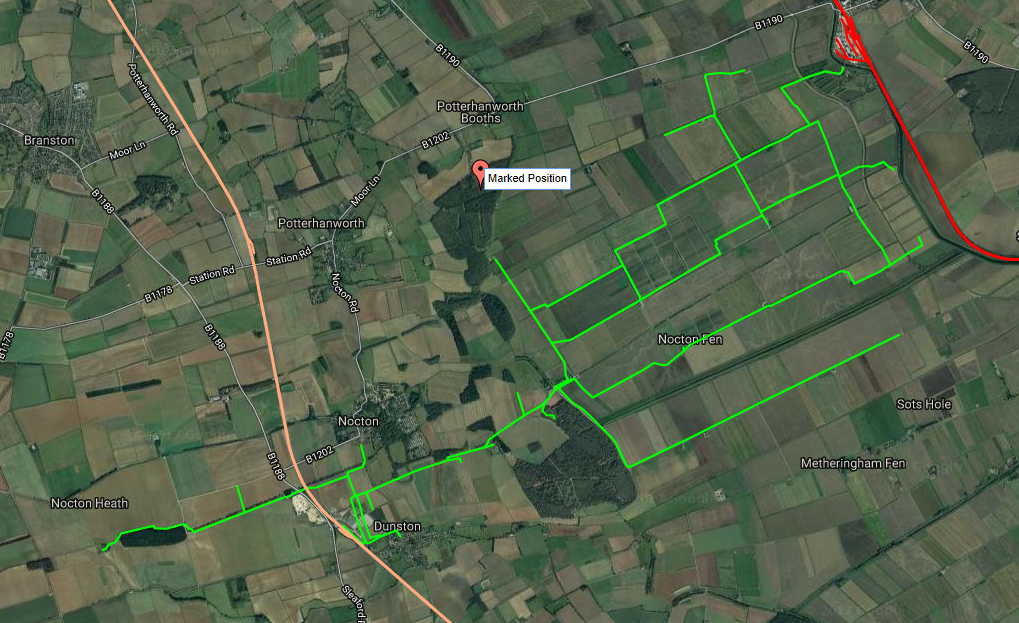
I have managed to locate a website (Rail Map Online) that shows the route of the Nocton Estate Light Railway overlaid onto a map so we can see its exact route over the topography of the area.


View focused on railhead

The full route of Nocton Estate Light Railway

Main extracts from:
  • 'The Lincolnshire Potato Railways by Stewart. E. Squires - ISBN 0 85361 352 4]
Minor extracts are from:

Wednesday, 30 May 2007

Personal Stories (Part 2)

From Horses to Computers – In 50 years, What Next?


by Mr Len Woodhead (Employed as a Foreman for Nocton Farms)

“I was born at Todd’s Farm, Nocton Fen (TD8) in 1937. At that time there were two cottages in the corner of the field which is now known as TD8. My father had come into Nocton Fen at the age of 18 as a second chap (2nd Waggoner) to a chap called George Reeve (later we saw his name on lorries).

This was at the Partridge Farm where he lodged until he married. There were eight horses at the Partridge. George looked after and worked four, and father the other four. At the time Dennis’s owned the estate.

The job was a seven day one, up at 5.30am to fetch in the horses and give them food ready for work by 6.30am. Sunday of course, was not worked, other than stable work unless it was a difficult harvest. The days in the fields working the horses would start at 6.30am with a half-hour break at 11.00am. Work would continue until 2.30pm (called Lowsing Time) when the horses would be brought back home. They would be groomed, fed and the stables cleaned out. The crew yards would be bedded with clean straw and only then would the Waggoners go in for dinner.

At about 5.30pm father would then come out again and ‘supper up’ (or feed) the horses. In the Summer he would be taking them into a grass field for the night – in the Winter they would stay in the Crew Yard.

In March 1932 Dad met and married my Mum and they moved to Todd’s. There he looked after and worked four horses, Bonnie, Captain, Star and Daisy. He used to do most of the drilling and potato ridging down on that section of the Fen and although he only had one eye he could plough and ridge or drill as straight as anybody.

I have the furniture bill from when they were married and it goes like this:
· Bedroom suite £10
· Settee suite £10.5s
· 4 rugs @3/6d each = 14s.0ds
· Table £2.2s
· 4 leather chairs @ 7/6d = £1.10s
· Armchair £1.2s.6d
· 1 ladies cane chair £1.2s.6d
· Oak sideboard £4.10s
· Mirror 5/11d
· Wringer £2
· Dolly Tub 5/11d
· Pegs 3/6d
· Clothes basket 2/6d
· Fire Kerb 12/6d
· Cloth horse 16/-
· 2 bedsteads @ £1.16s = £3.12s
· 2 spring mattresses @ £1.15s = £3.10s
· 2 wool mattresses @ £1.15s =£3.10s
· 2 feather beds @ 1/1d = £2.2s.0d

Total £49.1s.3d (all from Neale Bros in, High St, Lincoln).

The 3,000 acres in Nocton Fen was then in four sections, which each had a Foreman and about 40 permanent staff, plus about sixteen Irish labourers in season for hoeing/lifting and topping beet, picking potatoes and bringing in the harvest. Labourer’s wives would make up a potato picking gang during August and September.

The men on the lower part of the Fen mostly came from Bardney or over the Ferry from Southrey. At that time there were 28 houses inhabited in Nocton Fen, but they were occupied by Waggoners, Foremen and Stockmen etc. There were two blacksmith’s shops in the Fen – one near the Cathole Bridge, Todd’s Road and one at Lark Farm.

Apart from horses, of which there were between 70 and 80 in the Fen, there were also two sets of Ruston Ploughing engines or cultivators, and of course the Light Railway which joined all the farm yards from the rail head at Dunston to all parts of the estate.

The farm roads were only dirt roads so everything was moved by rail. No water was laid on, so all drinking and washing water was brought by rail – each house had old water tanks by the side of the railway line, with a piece of zinc covering them to keep out birds and soil.

Rations for the horses, pigs and beast were all brought by rail. Coal for the steam engines and Irishman’s fires were also brought by rail. Produce (potatoes, corn and peas) were taken by rail to Dunston. Sugar beet was also hauled by rail (Bardney factory was built in 1928), but it was taken down the Fen and emptied with forks into a pit on the Fen side of the river. The large iron bridge which you can still see today, carried a grab which carried the beet over the river and dropped it into railway trucks, where it was shunted around to the east side of the factory, before being emptied by forks again.

If you needed the Doctor he would bike from Bardney and leave his bike near the Fen road, put on his wellies and walk down to the farm yards. The houses were in fair condition, a coal fire in every room. The toilet was down the bottom of the garden, sometimes with two seats so you wouldn’t be lonely or frightened. You could take a candle with you and read the latest news on the toilet paper (Lincolnshire Chronicle).

Mum would have a large old wash-house with a steel copper, which of course was heated with coal. Out in the farm-yard would be ducks, cockerils and hens, a couple of pigs in the sty at the bottom of the garden and a few rabbits as well, so you didn’t need the butcher.

The butcher would come around, once in December and once in January to kill the pigs. That was always a busy day, up at 5.00am to get the copper going, as it had to be full of scalding hot water by 8am. The butcher would kill the pig after which we placed it on the cratch (a two wheeled trolley).

Scalding water would be thrown over the pig until the whiskers came off easily with scrapers. When that was done, the pig would be hung up in a shed or apple tree and cut open. The intestines would be taken out and the pig left to hang for about 4 hours.

The butcher would go into the house for a fried breakfast and to collect his money, and he would go on to the next farm. All in all in a Saturday morning he would probably kill about four pigs and by dinner time he had to start his afternoon visits to cut the pigs up into chines, flitchers and harris etc. These would then be salted, laid out in the floor of the pantry or in a salt box, and left for a month to cure, before being hung up on the kitchen ceiling until you wanted it for joints.

Mum would be busy all week making up fries to take round to friends around the Fen farm-yards and also making sausage, pork pie, brown and haslet, so you could guarantee if was pork for at least three weeks until the pork pies had gone.

We didn’t have a radio or wireless, so by the fireside at night under the paraffin lamp we would play cards, dominoes or help mum cut snips to make the rugs. We always had a dog and at least one cat – there being plenty of rats and mice you needed them around the farm. If it snowed too heavy in the wintertime, mum used to carry water from the delf and boil it for household use, because it didn’t need much snow to stop the Light Railway operating.

Footnote
In 1931, the Estate covered 7,000 acres. This was the time when 26 farms were thrown into one (making Mr JH Dennis’s farming enterprise). 7,000 acres, 7 miles long and three miles wide. 1,500 acres potatoes, 1,000 acres wheat, 500 acres of oats, 500 acres of barley, 280 acres peas. There was also sugar beet, beans and clover. There were 3,000 sheep, 2,000 pigs and 500 head of cattle.

There was 23% more labour employed than when it was previously divided into 26 farms. 10,000 to 15,000 tons of potatoes were produced annually, 50,000 bushels of wheat. As many as 260 tons of potatoes could be loaded per day for Newcastle – Sheffield – Cardiff – London.

Four threshing machines harvested all the peas, wheat and barley. The beet factory was built on part of the Estate, even though it was over the river.

Personal Stories (Part 1)

The Changes and Modernisation of Nocton


The old Ten Row houses were altered over the years to make them larger. This was done by making two houses into one. In 1983, the row was bought by Simons builders, stripped and modernised. When they were finished the houses were sold off and are as you see them today. After modernisation, they sold for around £24,000 each, in 1989.

Hall's Yard originally consisted of a farmhouse and a large barn, used in the past for fertiliser storage. Later it was used as a chitting house for seed potatoes. More recently the barn has been converted into a house. There were five garages used by the estate foremen for their vehicles, these have now been made into a bungalow.

At the other end of the yard was a large open waggon oval. This has been converted into a garage for Mr J Watt who has also built a house in the yard. In the opposite corner of the yard is a bungalow, which was made out of some old stables and the crewyard. This was done in the 50's to accommodate some poultry girls.

There were two other areas facing south which used to be stables and crewyards, one next to the manor house garden has been converted into a bungalow; the other one, which a few years ago was a shed for large tractors, is now part of the gardens and garage of the converted barn.

Wray's yard buildings consisted of the large buildings on the right hand side. In the 40's, these were a partly open crewyard for horses and bullocks, with stables at the rear. Later the fronts were bricked up and the large parts were used for chitting seed potatoes, after that they were used as tractor sheds. Now they are two lovely bungalows.

As you walk into the yard, looking straight ahead is the old barn, this was used for storing fertiliser and then later made into a seed potato chitting house. In the rear of the yard were further crewyards for bullocks and pigs. Some fine houses have now been built here.

The manor yard had a large dairy herd when I was a lad at Nocton school. It was quite an impressive farmyard at that time. There was a T.T. tested dairy herd and during the 50's some new bull pens were built, but on 11th May 1961 the last of the herd was sold.

After this date the crewyards were used for fattening bullocks and, for many years, all the lambing was done there. It has now been sold off to a developer to build ten houses. One or more of the old buildings were to be kept and made into houses in order to keep a little bit of the old character, but something went wrong and the whole site was demolished and cleared.

Source: this extract is taken from:
A Lincolnshire Lad Looks Back - Nocton Estate - The Home of Smith's Crisps
By Len Woodhead
Japonica Press £9.99
ISBN 095402229-7