Showing posts with label Sir George Gilbert Scott. Show all posts

Tuesday, 9 January 2018

Nocton Hall - grounds and gardens

Nocton Old Hall (- 1834)

Henry VIII, his fifth wife and his Royal party visited Nocton and stayed over night with young Sir Thomas Wymbishe and his attractive wife Lady Elizabeth Tailboys of Kyme. It is said that the large chestnut tree near the North main entrance was planted by Katherine Howard on 13 October 1541 at the behest of Lady Wymbishe and years later the tree was supported by props to stop it collapsing from its own weight.

N.B. As the Horse Chestnut was only introduced to the UK in the late 16th Century, this seems rather unlikely.

Plate 1: Chestnut tree
[photo taken 3 Oct 2011]

In 1672, Sir William Ellys called in the best professional architects and set about adjusting and enlarging his home to become one of the greatest houses in England. On the park wall to the west, opposite the hall, to provide a balanced view he had constructed the face of a Jacobean house into the wall (now known as 'The Pheasantry'). He extended the house through the wall to provide an eating house for travellers who cared to call. There were even tankards of ale, marked 'Nocton Hall' to complement the meals. A large pathway was constructed between the hall and this building to allow his staff to deliver the meals and ale each day without getting wet underfoot.

Plate 2: 'The Pheasantry'
[photo taken 29 May 2010]

It was Sir William Ellys who made substantial alterations to the parkland and estate. Large areas were  planted with oak, ash, lime and good quality hardwoods. This development provided Nocton with a landscape of incredible beauty. Snowdrops, bluebells and lilies of the valley grew in abundance, spreading as each season passed. In May, the scent of the flowers, wafted by a gentle breeze from the woods, gave a satisfaction that made one feel good to be alive. It still does even today.

Plate 3: Snowdrops in profusion
[photo taken 20 Feb 2014]

In mid winter on 29 Dec 1767, the Hobarts entertained at the Hall. Lanterns were festooned from the trees on the drive through the park adding a romantic touch for the arriving guests. It was George Hobart  who conceived the idea of planting a lime avenue to the eastern side of the hall. The trees were double planted and the avenue was about a mile in length towards the horizon. In time, these trees developed a canopy providing a fine feature in the Nocton landscape and Hobart further altered and remodelled the gardens and grounds.

Plate 4: Lime Avenue - east side of Nocton Hall

In 1773, St Peter's Church which stood only a few yards from the Hall, was completely demolished and rebuilt on the site of the current All Saints Church. The original graves and headstones are still in situ buried in the raised mound, just south west of the current Nocton Hall.

Plate 5: St. Peter's Church - North view, from a water-colour sketch
by Miss Louisa Charlotte Hobart B: Feb 1826

On 28 April 1827, Frederick John Robinson became Viscount Goderich of Nocton. Frederick and his wife, Lady Sarah Albinia Louisa Hobart, had a devoted love for Nocton which she had inherited on her father's death. There is a charming letter dating from the early years of the Robinsons' possession of Nocton Hall, which conveys the affection they had for the place.

Frederick Robinson writes to his mother on 6 December 1818: "We have certainly been very alert in all our improvements, and notwithstanding the shortness of our stay here, we have contrived to get as many irons into the fire as can well be managed at once ...  Sarah ... is become one of the first rate gardeners; and altho' undoubtedly by no means knowing in the botanical part of that science, she directs the proceedings of the gardener with all the airs of lengthened experience. How far this may result from my having recently become a member of the Horticultural Society, I cannot pretend to say, but the fact is undeniable & excites the utmost astonishment in all her ancient friends."

Concerning the gardens, The Lincoln and Lincolnshire Cabinet criticizes the' infant avenue of elms' in front of the house for being old-fashioned, at a time when axial planning in garden design was anathema. No doubt the elms were planted to replace 'the avenues rooted up' which Torrington had observed in 1791. It is likely that the avenue was replaced by the Robinsons.

[N.B. Lincoln and Lincolnshire Cabinet for 1828, 8. The avenue in question does not appear on an estate plan of 1809, in the possession of Mr Christopher Howard, which was prepared in the time of the Fourth Earl of Buckinghamshire (d.1816). It is not plotted on Greenwood's Map of Lincolnshire of 1830 (based on surveys of l827 to 1828), but it is on Bryant's Map of Lincolnshire of 1825 to 1827]

After the Viscount resigned from office, he was created Earl of Ripon on 13 Apr 1833. Just over a year later, Nocton Old Hall sadly succumbed to fire on 15 Jul 1834 and all that remained was a shell.

Plate 6: Nocton Old Hall (West elevation)
from a drawing by D Jewett


Plate 7: A.W.N. Pugin pencil sketch of the ruins of
Nocton Old Hall, 1834 [Lincoln Cathedral Library, Willson Collection]

The 'new' Nocton Hall (1841 -)

The foundation stone for the current Grade II Listed Nocton Hall was laid on 26 Oct 1841.

Plate 8: Nocton Hall Foundation Stone - laid 26 Oct 1841
[N.B. The inscription is in Latin, but reads in translation:

"This house was founded in about 1530 during the reign of Henry VIII. Enlarged in 1680 by Sir William Ellis. Then George Buckingham finally received it in 1780. Robert Earl of Buckingham's daughter married Frederick John, Earl of Ripon. Fire destroyed the house in about 1830 and another was built in the same place in 1841."]

The architect was a William Shearburn of Dorking (a Nocton born lad) and it was his father, Joseph (a joiner on the estate) who oversaw the building work. It is written that Sir George Gilbert Scott, one of Sarah's close friends, graciously offered his services free and acted as an advisor to William Shearburn. It took ten years to complete.

Not only was a new Hall built, but a new church was constructed - All Saints Church - designed by Sir George Gilbert Scott in the "Gothic Revival" style - after demolishing the second St Peter's Church.

Much of the surrounding woodland was carpeted in snowdrops, wild garlic and daffodils.

It was the first Marquis of Ripon, George Frederick Samuel Robinson, who planted the evenly spaced Wellingtonias  bordering the driveway to Nocton Hall in 1887, just three years after his return from India where he had completed four year as Viceroy.

Plate 9: Wellingtonia - Nocton Hall
[photo from 1998]

It was also in 1887 when the famous West lawn of Nocton Hall (now scrubland with saplings), was used by the Marquis to hold a political meeting attended by over 10,000 of his Liberal supporters from all over Lincolnshire. He gave his speech from the garden steps which gave a suitable elevation for his address.

Plate 10: View of the W elevation showing the garden steps
from where the Marquis addressed his Liberal supporters

In the census for 1891, there is an entry for 'Nocton Hall Gardens' showing that a John Ridsdale was the gardener.

Following the sale of the Hall and estate to George Hodgson (a friend of Ripon), his eldest son John Hodgson came to Nocton Hall in 1895, to assume responsibility. It was John who constructed the extensive lake to the north of the Lime Avenue, to the east of the Hall. It was pump fed from Dunston Beck, thereby making it possible to stock the water with trout.

Plate 11: View of the lake to the E of Nocton Hall

By the time of the census in 1901, there is no mention of John Ridsdale, but a John Montgomery appears. Too many John's for my liking!

The character of the gardens and grounds was described in a Country Life article dated 28 Sep 1901 "... it will be noticed that broad lawns and dark masses of wood, with an abundance of flowers and evergreen bushes are the chief elements in the attraction of this pleasant house... it has a modest and admirable charm of its own, and is an example of what may be accomplished by many, who may bring Nature in her most pleasing form into the neighbourhood, and invest the surroundings of their houses with some of her fairest graces."

Plate 12: 'Nature in her most pleasing form...'

John Hodgson had a great fondness for marble statues, carved in seductive poses, he placed them in various locations around the grounds. These ethereal figures used to send shivers down the spine of estate workers returning late through the avenue of trees, especially as one could never be sure where they would pop up next.

When John died and his 25-year old son Norman Hodgson took over the Hall and estate, he had these statues removed and rehoused in Nocton Hall, disapproving as he was of his father's hobby. He also set out to improve the grounds by having the flower borders enlarged and stocked with a full variety of shrubs and herbaceous plants. Rose borders were created and filled with many varieties, providing a colourful display.

Species of rhododendron were first planted by Lord Ripon on the estate, but this collection was increased by Norman to add a mass of colour to the 400-acre Nocton Wood, which was already famous in Lincolnshire for its fantastic display of rhododendrons, lilies of the valley and bluebells. There is an historic oak in Nocton Wood, thought to be a old boundary marker, called 'The Nine Brethren', so-called for its nine separate trunks.

Plate 13: Bluebells in Nocton Wood adjacent to public footpath
[photo taken 20 Apr 2017]

The head gardener however, was rarely seen tending the gardens. His penchant was to perfect the chrysanthemum. The Squire, on his daily rounds, soon noticed that the junior gardeners seemed to be doing much of the work and with several acres of walled fruit and vegetable gardens, it became a laborious hunt for said head gardener. He was finally found in the greenhouse striving to produce the finest chrysanthemum. It resulted in Nocton winning the coveted chrysanthemum prize for three consecutive years at the Royal Horticultural Hall at Westminster before 1914.

The Garden House, Coachman's Cottage, Gate Lodge, orchards and walled gardens in the grounds of Nocton Hall were all to be included in the forthcoming sale of the estate to William H Dennis and Sons of Kirton in 1919. There is a fine memorial to Evangeline Brewster Dennis, wife of one of the Dennis family in the churchyard of All Saints Church.

Plate 14: Old fruit trees with walled garden in background
[photo taken 3 Oct 2011]

With the passing of Nocton Hall and gardens into corporate ownership, one can only presume a gardener and his assistants continued to maintain the grounds during its time as a convalescent home for wounded American soldiers. The 1937 Prospectus for the Boys Preparatory School mentioned: "The House is surrounded by beautiful lawns and private walks and approached by a long drive from the Lodge gates..." However, there is evidence that as time went on, especially during the period of WW2, there appeared to be a slow and inevitable decline.

It was only when the Air Ministry took over responsibility in 1946 that things really improved again, with the gardens and grounds being meticulously maintained.

Walking around the woodland and grounds surrounding Nocton Hall today, you can still see the template of the private walks lined by mature trees, obscured by the neglected laurel hedging that has become much too large for its location. There is a collection of cherry blossom trees surrounding the former lawn to the South of Nocton Hall that are very impressive in Spring. You can still experience the grandeur of the large Wellingtonias and feel the soft hollow, fibrous bark in russet red tones.

Plate 15: This is how the 'Laurel Walk' on S side
of Nocton Hall used to look

Even today the grounds are well-wooded and many trees extremely fine, so much so they are under Tree Protection Orders... unfortunately though, the lime avenue to the east is no longer there, nor is the trout lake.

Plate 16: Old map clearly showing the Lime Avenue
and the trout lake

Many trees in the grounds of Nocton Hall now require attention and there are masses of saplings that need to be removed to allow more light to reach the woodland floor. However, work is long overdue to give these fine specimens the care and attention they deserve. That said, it is still a pleasant landscape in which to wander and dream what this place was like in its heyday.

Sources of Information:
  • Country Homes and Gardens: Nocton Hall - The Seat of Mr J Hodgson (Country Life 28 Sep 1901)
  • EJ Willson and the Architectural History of Nocton Old Hall (Author: Carol Bennett)
  • Nocton – The Last Years of an Estate Village – Vol 1 (ISBN 978-1-873257-80-7)
  • Nocton – The Last Years of an Estate Village – Vol 2 (ISBN 978-1-907516-13-9)
  • Nocton Hall Preparatory School for Boys 6-14 Years of Age for the Public Schools and Royal Navy (1937)
  • Sheila Redshaw Collection
  • The Revelations of an Imp (Author: Douglas Craven-Hodgson)

Sunday, 8 April 2012

A Prime Minister's Home

After attending All Saints Church this morning on Easter Sunday, I later came across an article when cataloguing Sheila Redshaw's collection of memorabilia.  I thought it would be nice to share this with you:

"Nocton.  A green and pleasant place a few miles south-east of Lincoln, it has a Hall which was the home of a Prime Minister, and a church which is his memorial and his last resting place.  About a mile away, on the edge of Nocton Fen and close to Nocton Wood, where lilies of the valley grow in great profusion, is the site of a priory founded in the time of King Stephen.

This priory, for Austin canons, was founded by Robert D'Arcy, whose father, Norman D'Arcy, a companion of the Conqueror, was first of a family which held this manor for 600 years.  In Charles the Second's time the estate was sold to Lord Stanhope, and then passed to Sir William Ellys, whose monument is in the church.  Later it passed to George Hobart, afterwards third Earl of Buckinghamshire, and the marriage of the fourth Earl's daughter brought it to the rising young politician who as Chancellor of the Exchequer was nicknamed Prosperity Robinson, and as Viscount Goderich succeeded George Canning as Premier.  He died as the Earl of Ripon in 1859, and three years later his widow built Nocton church in his memory.  It took the place of a poor church built by George Hobart, who had pulled down the old one because it was too near the Hall for his liking.

Designed by Sir Gilbert Scott in 14th-century style, and built of Ancaster stone, it is one of the most sumptious modern churches in all Lincolnshire, with a tower and spire 130 feet high, and a porch with niched figures of the Madonna and Child, St Peter, and St Paul, John the Baptist, and John the Evangelist.  The interior is dignified by an arcade on rich clustered columns, but is chiefly notable for the richness of decoration in carving, painting, and windows.  The heads of Peter, Paul, and of Our Lord are in niches on the lovely pulpit of stone and marble, and the alabaster reredos (by Italian craftsmen) shows under three gilded arches Christ carrying the Cross, with an angry man about to strike Him and a Roman sildier on a rearing horse behind; the Crucifixion, with the three women and the disciples; and the Entombment, with Mary Magdelene kneeling.  On each side of the reredos the wall is arcaded, the arches being filled with engraved figures of Apostles, Evangelists, Martyrs and Saints.

Elsewhere the walls are adorned with sacred subjects.  In the chancel are canopied paintings of Apostles and Evangelists, each with his symbol, and over the chancel arch Christ appears in Glory, with a great company of kneeling angels and saints.  More unusual are the paintings on the west wall of the nave - graphic illustrations of the Israelites entering the Promised Land, the Egyptians drowning in the Red Sea, and Noah with his family and the animals going into the Ark two by two, goats, asses, rabbits and snakes among them.

The windows form another fine gallery of pictures.  The east window has a central figure of St Michael with angels and a great multitude of men, women, and children round him; and 24 Elders below, casting their crowns before the Throne.  One of the side windows of the nave has figures of St Hugh of Lincoln and St Theodore, and a second has Oswald and Etheldreda.  A third window, showing St Aidan with the stag and the Venerable Bede writing, is a memorial to a descendent of William Brewster, one of the Pilgrim Fathers, and has smaller scenes depicting sunrise and sunset at sea and the Mayflower sailing the ocean.

The fine west window of the nave, with four scenes showing the gift of Isaac to Sarah, and four more of the gift of Samuel to Hannah, was the work of Clayton and Bell and is a memorial to the Countess of Ripon the builder of this church who died in 1867.

Among the monuments set up in memory of members of her family three are specially notable.  The first is of white marble with an urn to her father, Robert Hobart, the fourth Earl of Buckingham, Secretary of State for the Colonies in the first years of the 19th century and the man after whom the capital of Tasmania is named.  The second is to her uncle, Henry Lewis Hobart, vicar of this church for 33 years and Dean of Windsor as well - a white marble memorial with two kneeling women and cherubs above.  The third is the monument she raised to her husband, the first Earl of Ripon; it is under an arch between chancel and chapel, a stately altar tomb of Carrara marble bearing a figure of the Prime Minister in a long robe, his hands folded, his fine features in repose - a beautiful sculpture by Matthew Noble, the Yorkshireman who gave Liverpool, Manchester and London many fine statues.

The oldest memorial, and the only relic of the old church, is a pompous 17th-century array of marble columns, sculptured urn, helmet, shield, and Latin inscription; it is to Sir William Ellys, who built anew the Hall that Thomas Wymbish had erected in 1530, and which was visited by Hentry VIII and his fifth Queen, Katherine Howard.  Here she came with the ruthless king on a journey which was to end in charges which sent her, still a girl, to join her cousin Anne Boleyn in the chapel of death at the Tower.

Fire destroyed the old Hall in 1834, and the foundation stone of the new (handsome with mullioned windows, tall gables and chimneys, and terrace leading down to a lawn) was laid by Viscount Goderich's 14-year-old son, who was born in the most famous house in England (10 Downing Street) during his father's premiership.  He was to be for forty years associated with Gladstone.  Later in life, when he had become first Marquis of Ripon, and a Roman Catholic, he sold the Nocton estate.  He died in 1909 at his Yorkshire home, Studley Royal, and was buried there in a modern church even more sumptious than the one raised in his father's memory here.

Many fine trees surround the Hall, a veteran among them being a chestnut with a girth of about 35 feet and its great branches borne by a company of props."

Source: The Kings of England - Lincolnshire (1949) - P278/280
____________________________________

Friday, 16 September 2011

Nocton Hall - Revelations of an Imp - Chapter 11

Lord and Lady Ripon

Frederick John Robinson - Born 1.11.1782 - Died 28.1.1859
Lady Sarah Albinia Hobart - Born 22.2.1793 - Married 1.9.1814 - Died 9.4.1867

Lady Sarah Hobart was born the year before her parents went out to Madras at the time her father took up his appointment as Governor for this state in the south east of India. Madras was an important commercial port with a growing population centred on the East India Company's commercial initiative throughout eastern Asia. Sarah's mother found the heat oppressive and as time passed, her vitality languished. Slowly her health declined. Her thoughts and memories centred on the home of past years in Co. Cork. The cool breezes and refreshing rain of south west Ireland could have lifted her spirits but in Madras she succumbed steadily to the hot humidity. Margaretta desperately fought her private battle with her failing health, to look after her daughter and support her husband, but after three years, all was lost. She died in 1796 after the birth of her baby son John, who passed away just after his mother's death. Robert was left a widower with only Sarah to remind him of his lovely wife. Perhaps in this difficult time, his little daughter, although so young, developed the beginnings of her strong character which was to give her strength in the battle of life ahead.

Two years before her father's fatal accident in St. James's Park, Sarah married Frederick John Robinson on 1st September 1814, the second son of the Earl of Grantham. In 1815 Robert, the fourth Earl, became a proud grandfather when Sarah gave birth to a daughter, Eleanor Henrietta Victoria, on 22nd May. Their second child, a boy, born the following year, lived only two days.

Her husband was member of Parliament for Ripon and Joint Paymaster of the armed forces. Born in February 1782 he was 11 years older than Sarah. In high society and as Chancellor of the Exchequer, he had acquired the nickname of 'Prosperity Robinson'. Educated at Harrow and St. John's, Cambridge, his career in politics as a Tory moved rapidly up the ladder of success. When only 41, he went to No. 11 Downing Street, the post he held for four years. Tragedy once again struck Sarah, in 1826 their eleven years old daughter Eleanor died. On 28th April 1827 he became Viscount Goderich of Nocton. The title of Goderich descending from the Duke of Kent, through Jemima, his aunt, the countess of Grantham. In August of the same year, George IV offered him the Premiership.

In Lord Liverpool's administration of 15 years from 1812-1827, Frederick constantly held a senior cabinet post. It was, therefore, natural that the King, on George Canning's death, would call on Frederick to lead the government. Within six months, Goderich realised he could not command the full loyalty of his cabinet. The King's statements were an added embarrassment. Instead of giving the Prime Minister his full support, his remarks were publicly critical of the Tory party. The Duke of Wellington was at hand. A father figure of the nation, and who better than this famous soldier to take the Tory leadership into his safe keeping. Goderich recommended Wellington to the King as his successor. The Duke continued to lead the Tory party for the next three years. The most notable achievement and a unique first which will be remembered for all time, during the Premiership of Goderich was when Sarah, having conceived in No. 11, gave birth to their third child in No. 10 Downing Street on the 4th October. The nation rejoiced with the Prime Minister and his wife on the arrival of George Frederick Samuel Robinson who was to become one of our country's greats.

After the Viscount's resignation from office, he was created Earl of Ripon on 13th April 1833. He served in Sir Robert Peel's cabinet on the return of the Tory party to power and continued in politics until 1847 when he withdrew from public life during the Whig Premiership of Lord John Russell.

Sarah and Frederick had a devoted love for Nocton which she had inherited on her father's death as his only surviving child. The management of the estate and welfare of the villagers in Nocton and Dunston created several problems. The first being the little Church built by her grandfather. St. Peter's in Nocton required major modifications and maintenance. The Robinsons ordered the work to go ahead and was paid for by the villagers and tenants with a large donation from the Hall.

Secondly, the Fen, always a farming problem, had further drainage difficulties. The old wind engine was replaced with a steam engine costing £4,000, against strong opposition from different authorities who doubted the Witham banks would withstand the force of water ejected by a more efficient method of drainage.

Nocton's Mill, between the village and the Sleaford Road, was burnt down in 1833. A further fire in the village alerted the Earl's steward who then doubted whether these disasters were the result of accidents. The Earl ordered a fire engine of the latest design to safeguard the estate property in the future.

The House of Commons was burnt down in the disastrous fire of 16.10.1834. The same year, on 15th July at 9 o'clock on a Tuesday evening, Richard Semper with other estate craftsmen were walking up from Nocton Fen when, in the failing light, they saw flames licking out from under the eves on the Hall roof. Nocton Hall was ablaze. Not a single man on the estate failed to turn up and lend a helping hand in a vain battle to save this magnificent building.

The new fire engine proved useless. The fire spread as lead and straw in the roof formed a volatile mix to accelerate the spread of flames. It was soon clear that nothing could save the Hall and every attempt must be made to get out the contents. A salvage operation was immediately mounted and with considerable risk, the fire fighters carried out the major part of the Hall's furnishings including pictures, tables and a chest which contained the toys of Lady Eleanor, the only daughter of the Earl and Countess, who had died so young only a few years before. All the books, a quantity of wine, bed linen and blankets were passed by a human chain away from destruction. 150 years later, the same blankets saved from the fire are still in use. What a testimony to the quality of Lincolnshire longwool ewe that after so long, the wool can still provide comfort to human beings!

Was the Nocton Hall fire an isolated disaster? Was there somebody who was hell bent on the destruction of the House of Commons as well as Nocton Hall?

The Tory party had passed the Poor Law Amendment Act, a measure to tighten up Government expenditure which even in 1834 was necessary to balance the nation's budget. In Dorset, a quiet country area of southern England, the farm workers were striving for an improvement in their way of life, but the now famous group 'The Tolpuddle Martyrs' were harshly victimised to discourage a working class revolt that might get out of hand. Could these events have a connection with the Nocton Fire?

In politics an individual in high office and a faithful servant of our country can become the target of vengeance for a vindictive 'nut case'. Such a person may be prepared to destroy the structural heritage of a democratic nation, in a mean effort to satisfy a personal hatred. Such an imaginative obsession grips the mind of a man or woman and there is no easy way of knowing when a government action can trigger a human reaction that ends in disaster to both property and person that are hurtful and callous.

The Nocton Hall fire was extinguished 15 hours after the flames had been seen and only a small part of the north wing remained intact. This part was later joined to the new Hall as a lasting memory of the original Manor building which dated back to the early centuries. It was also an ancestral link between two historical families in the Earl's heritage.

A certain Metcalf Robinson, created Baronet in 1661, united D'Arcy to Robinson on his marriage to the daughter of Sir William D'Arcy of Witton Castle, Co. Durham. Nocton had completed the link to join the ancestry of the D'Arcys with the present owners.

Sarah felt the loss of her home deeply, so with their young son, only 7 years old, they all moved to a house on the Branston estate to remain near the burnt out home. Plans were slowly formulated for the restoration of their property. Priceless antique furniture had been scorched or severely damaged - pictures destroyed or stained. The salvage work was enormous, but everybody, including tenants on the estate, set to with total dedication to restore the contents of the Hall.

The Noble family, with their special skills in woodwork, took on the repairs to the furniture which had been distributed in vacant dry barns until required for skilled surgery by cannibalising undamaged wood from burnt furniture and repairing the slightly damaged pieces.

A full inventory was completed and the responsibility of restoration designated to specialists in the village and in Lincoln who would undertake the repairs.

Sarah was a born administrator and only a few weeks after the fire, the estate knew it was only a matter of time before a new Hall would again stand in the park to house the contents now scattered around the barns on the estate. Henry Lewis, Sarah's uncle and Vicar of Nocton, lent his full weight to encourage and rebuild the family home. What an inspiration the Dean's sympathy and deep understanding were to everybody and not least, to his dear niece who had now suffered so much with the death of two children and the loss of her family home.

Sir George Gilbert Scott, the famous Victorian architect, one of Sarah's close friends, graciously offered his services free and acted as an adviser to William Sherbourne of Dorking, the son of an estate carpenter, in designing the present Hall.

There were still problems to overcome before the new Hall could be built, but the tenants offered as an inducement to get the work underway, the haulage of all materials as well as assistance in the actual construction of the new building. The greater part of the stone for the Hall came from the estate quarry close to the Lincoln-Sleaford Road, but the principals were of a harder and more durable quality from a stone supply near Ancaster. On 26th October 1841, just seven years after the destructive fire, Frederick and Sarah's son, George, at the age of 14, laid the foundation stone on the north side bearing the inscription of essential facts relating to past history. The new Hall, seen in all its glory, is a fitting tribute to George Gilbert Scott. His countryhouse masterpiece.

In gratitude for help and sympathy given from the estate and tenants after the loss of the Hall, Lord and Lady Ripon set about rebuilding almost the entire village of Nocton. In 1862, the Countess pulled down the 18th century Church of St. Peter. It was far from compatible with the new Hall and in token of Sir George Gilbert Scott's past generosity, she commissioned him to design and supervise the construction of the new All Saints. This beautiful village Church in a unique country setting is now regarded as one of the finest modern churches, not only in Lincolnshire, but in Great Britain. The steeple towering into the heavens acclaims its presence to those who wish to visit such a marvellous and sacred holy building. When you walk down the footpath to All Saints, a feeling of awe lifts one's eye to the heavens. The spire points your vision to the sky and on entry to the Church, a feeling of peace descends to give fulfilment to your soul.

All Saints was consecrated by Bishop Jackson 16th December 1862 and Lady Ripon, through her resolve, had made a consecrated home the last resting place for her husband who died on 28th January 1859 a fitting Church for a Prime Minister.

The Countess outlived Frederick by eight years. Beloved Sarah, to whom Nocton owes so much, died on 9th April 1867. Not only was the Poor House rebuilt by her generosity, but many of the present homes in the village. Their construction in Nocton stone was always in character. The rows of houses and cottages blended with the surrounds, giving the village a gentle appearance when softened with views of hardwood trees standing proudly at the sides of the roadways.

Towards the Church and old school, Lady Ripon left ample space for lawns broken by footpaths leading to the houses and school. Steddles were placed at regular intervals to protect the grass from wagons rutting the lawn with their wheels and confine transport to the roadway which leads down to the Church and vicarage.

According to the season of the year, much of the churchyard and surrounds glory in large carpets of snowdrops, followed as the year unfolds by a massive display of wild daffodils. In the eye of a small child seen looking at nature's spring beauty, enhanced by the care of man, gives this part of Nocton Village a glimpse of their 'Garden of Eden'.

The Countess regarded the village with the same critical eye that influenced her work in developing the natural charm of the park and flower borders surrounding the Hall. She set the highest standard with the result that everybody tended and cared for their own gardens with equal enthusiasm. An air of friendly competition prevailed that made Nocton one of the most lovely villages in Lincolnshire. Today, this spirit lives on and the gardens are just as beautiful.

When Lady Sarah Ripon died, the estate lost a gallant and courageous friend. In her will, she placed on record her love for her home and people who had stood affectionately and firmly with her in times of adversity. She declared her interest in the future, now in the hands of her son George.
_______________________________________________________

Tuesday, 29 May 2007

All Saints Church, Nocton (Part 2)

The New Church


The most impressive memorial to 'Prosperity' Robinson and Lady Sarah, however, is the present church of All Saints. Its Georgian predecessor (see Early History) had never been a satisfactory building, and though only 40 years old when the couple inherited the estate, was already decaying rapidly. By 1845 its western wall was dangerously cracked, a pewter bowl (still used for baptisms) was being used as a font - the mediaeval font having been exiled to the churchyard - and there was a bookshelf above the altar. Since it only seated 200 people (plus 40 children in the gallery) it was also too small for a parish whose population numbered 510 in 1851. But perhaps this scarcely mattered, since the average Sunday congregation in that year totalled only about 100 adults. The explanation, according to Vicar Edward Wilson, was that; 'The parish being nine miles long, several families who are from three to five miles from the parish church rarely or never attend it, but go elsewhere'.

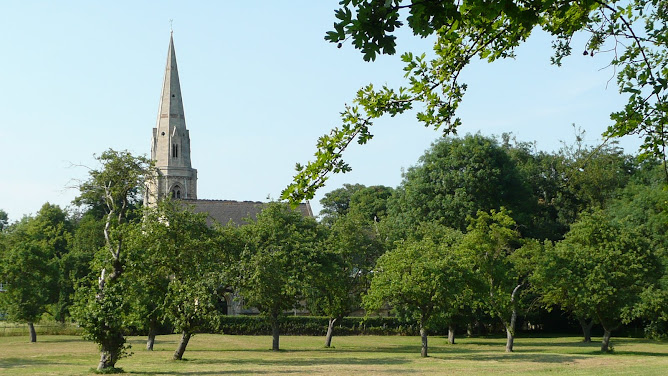
All Saints Church, Nocton [North side] - 30 Jun 2009
copyright Geoff Hall
Lord Ripon had intended to replace the old church with a new and more suitable building: but before he could do so, he died aged 76 in January 1859. His widow Lady Sarah therefore undertook the work, as a memorial to her deeply loved husband and a shrine for his tomb. By this time imitations of mediaeval Gothic architecture had come to be regarded as the only acceptable style for new churches, especially among the 'High Church' party to which Lady Sarah belonged. She thus employed the most respected and respectable of Victorian 'Gothic Revival' architects to design her church: this was Sir George Gilbert Scott, who had begun his career as a builder of Elizabethan-style workhouses and lunatic asylums, but had turned to churches (his first was St. Nicholas, Newport, Lincoln) and undergone a 'conversion' to Gothic Revivalism.

At Nocton, Scott chose to imitate the 'Early Decorated' style of c.1300, then regarded as the 'best' period of Gothic architecture. Built with no expense spared, the church was probably begun in 1860, being consecrated on December the 16th, 1862 and dedicated to All Saints: this was a new dedication, for previous Nocton churches had been dedicated to St. Peter. It was chosen in honour of Lord Ripon, whose birthday was November the first, or All Saints Day.

All Saints church, however, was not quite complete when Lady Sarah died in April 1867. A south aisle and south porch had been included in the original design, and these were added in 1872 by her son the Marquess of Ripon 'as a tribute of reverential affection to his mother'.

The Marquess, a deeply religious man as well as a successful Liberal politician, was at this time a leading Freemason: but two years later he suddenly announced his conversion to Roman Catholicism, though he apparently returned to the Anglican church before his death in 1909. He is buried in the magnificent Victorian church of Studley Royal, near Fountains Abbey, North Yorkshire. This 'sister church' to All Saints was built by the Marquess in 1871-8, as a memorial to his brother-in-law Frederick Vyner, who was murdered by Greek brigands. It is well worth a visit, as is the sombre and indeed rather sinister church of Christ the Consoler at Skelton-cum-Newby, North Yorkshire, also built during the 1870s in memory of Frederick Vyner.

The Marquess sold the Nocton estate in 1889, but before he did so he financed the finishing touches to the furnishings of All Saints. These provoked many admiring comments, which sum up the spirit behind the building of Nocton's church, and indeed of the Victorian Gothic Revival it so admirably typifies. 'We cannot take our leave of Nocton', enthused the Lincoln Diocesan Architectural Society in 1872, 'without referring to the unstinting munificence which is evident in every part and detail, both of the church itself, and of its furniture. Nothing has been neglected or regarded as too insignificant to deserve reverential care. Would that there were more parish churches in our great diocese where the ruling principle was as markedly the determination not to give the Lord of that which doth cost them nothing'.

A walk round the church


All Saints church was commissioned by Sarah Albinia, Countess of Ripon; designed by Sir George Gilbert Scott in imitation of the 'Early Decorated' style of c.1300; and built by Mr. W. Hudleston. It consists of a tower and spire, nave, and chancel with attached 'mortuary chapel' and vestry, all built between 1860 and 1863; and a south aisle and south porch, added in 1872. The entire church is constructed in best-quality Ancaster stone from mid-Lincolnshire, and roofed with brindled tiles from Broseley in Shropshire.

The exterior


The church is usually approached from the north, via the spacious churchyard. This gives a good view of the nave and the lower chancel, whose windows (like many others in the church) are filled with 'plate tracery' imitating the style of c.1300. The tower, whose lowest stage forms an entrance porch, rises into an octagonal belfry, topped by a fine spire reaching a height of 120 feet. The belfry houses a peal of six bells, given by Lady Sarah in 1865: they were cast by Messrs. Mears at the Whitechapel Foundry. Their weights and inscriptions are as follows:
1. BLESSING. 4 cwt.; 2. HONOUR. 4 cwt, 1 qrt, 20 lbs.; 3. GLORY. 4 cwt, 3 qrs, 27 lbs.; 4. POWER. 5 cwt, 1 qrs, 24 lbs.; 5. BE UNTO HIM THAT SITTETH ON THE THRONE, 6 cwt, 2 qrs, 19 lbs.; 6. AND UNTO THE LAMB FOREVER, 8 cwt, 1 qrs, 11 lbs. Total weight 1 ton, 13 cwt, 3 qrs, 17 lbs.

The inscription comes from the last words of Handel's 'Messiah', and is an adaption of Revelations 7:12. Round the corner from the tower is the west window, its two pointed arches topped by a roundel, and then the south side of the church. This south side is quite different in appearance from its northern counterpart. Above the nave south aisle (added in 1872) is the clerestory (or 'clear storey') of repeated 'blank arches', containing four small windows which give extra light to the interior. Then comes the protruding vestry with its chimney, and the 'mortuary chapel' housing the tombs of the Earl of Ripon and his family.

In the churchyard near the porch lies the ancient parish font of Nocton, sole surviving relic of the mediaeval church of St. Peter demolished in 1773: an octagonal bowl resting on 'ballflower' ornaments, it probably dates from the 14th century. The fine vaulted porch itself was added in 1872. Its buttresses display statues of four saints: on the western buttress is St. John the Baptist in his camel-skin cloak; St. Peter, with his keys, stands left of the door; St. Paul, with his sword, on the right; and St. John the Evangelist on the eastern buttress. On the porch gable is an image of the Virgin and Child, and the inner door is flanked by pillars displaying some of the 'fine and rich carving' much praised when the church was built.

The interior


The interior of All Saints also provoked tremendous enthusiasm from the Victorians, and what now makes it especially interesting is that it remains almost completely unchanged since the day it was finished. Particularly attractive is the original decorative colour scheme; its dominant shades of maroon and red-brown are used for walls and wall-paintings, roofs, and even the heating radiators.

The nave


The nave is unusually lofty by comparison with its height and width. The fine timbered - roof of its main aisle takes the form of a trefoil or clover-leaf,and like the sloping roof of the south aisle is stencilled with a pattern of flowers. Such clover-leaf roofs are rare in English churches, and Scott probably borrowed the idea from one of the European buildings he often visited. From there, too, he derived the rectangular abaci of the clustered pillars of the south aisle - that is, the flat sections at the top of the pillars, between the band of intricate carving and the base of the arches. These were the one feature of All Saints criticized by the Victorians, who preferred English-style round abaci, and thought Scott's design 'foreign-looking'.

Immediately to the right of the entrance door is the marble monument of Dean Henry Hobart (see above, History), a typical early Victorian composition by G.P. White. Oddly enough, it does not show the Dean himself, but portrays his sorrowing wife (d.1867) and his daughter, the 'Miss Hobart' who designed All Saints' east window. To the left of the door, on the west wall of the south aisle, stands the late Georgian memorial of Henry's brother Robert, 4th Earl of Buckinghamshire d.1816 (see above, History), carved by William Bacon and transferred here from the Georgian church.

The west wall of the nave itself displays some of the best of the red-outline wall-paintings which are among All Saints' most delightful features: taken together, they form the most complete scheme of Victorian figure painting in any Lincolnshire church. To the left of the central war memorial is a charming Noah's Ark scene, including rabbits and some unusually amiable-looking snakes: to the right, the Israelites are seen landing after their miraculous Red Sea crossing, while Moses summons up the waves to drown their Egyptian pursuers. Above, flanking the window, are four saints, not all of them officially canonised. On the left stands Bishop Remigius, founder of Lincoln Cathedral; then comes St. Guthlacof Croyland, Saxon founder of the Fenland abbey; then St. Mary Magdalen; and on the right - most surprisingly - 'Little St. Hugh' of Lincoln, with cross and martyr's palm. Not to be confused with the sainted Bishop Hugh of Lincoln, this child was alleged to have been ritually crucified by Jews in 1255, a wicked slander which provoked a wholesale attack on the Jews of Lincoln. Venerated as a martyr, his body was later enshrined in Lincoln Cathedral, but the tales about him had long since been discredited when All Saints was built. This painting, indeed, is almost certainly the only post-Reformation representation of 'Little Saint Hugh' in an English church: how it came to be included in Nocton's decorative scheme is a mystery.

The west window in this wall is filled with Victorian stained glass by the firm of Clayton and Bell, commemorating the Countess of Ripon who built the church. It depicts the Old Testament figures Abraham, Sarah, Isaac, Hannah and Samuel, with scenes from their lives. Below and to the right stands the elaborate Victorian font of 1862, carved in Caen stone from Normandy with pillars of green Irish marble.

To see a piece of equally opulent display, though of a quite different style and period, pass through the nearby doors into the tower. There stands the towering monument of Sir William Ellys (d.1680), brought from the mediaeval church. Sir William was the great-uncle of the builder of Nocton Old Hall (see above, History) who erected this monument. Its Latin epitaph records that he died a bachelor at the age of 77, and that he was a Justice of the Common Pleas: but it does not mention that he had been a zealous Parliamentarian and Oliver Cromwell's Solicitor-General, achievements best forgotten by the time his memorial was set up during Charles II's reign.

The north wall of the nave is stencilled with pretty red-brown 'diaperwork', and its window display stained glass of early twentieth century date. That nearest the west commemorates Edward Howard, a churchwarden who died in 1922: it depicts Bishop St. Hugh of Lincoln, holding a model of Lincoln Minster, and St. Theodore, an early Archbishop of Canterbury, holding a model of Canterbury Cathedral. Below them are excellent pictures of Nocton's Georgian church (left) and Nocton Old Hall. The middle window is also interesting, though its subjects might not now be thought suitable for a church. It remembers L.B. Wray, killed while serving with the Tank Corps during the Battle of Cambrai in 1917, the first occasion when tanks were used in significant numbers. Below figures of Saints Oswald and Etheldreda, it therefore depicts an early tank and a machine gun, and in the topmost light is the Tank Corps badge. Between this window and the next is a tablet to a steward of the Nocton estate, and then comes a window to Evangeline Dennis: proudly proclaiming her descent from one of the Pilgrim. Fathers, it shows the Mayflower sailing westwards, beneath figures of St. Aldan and the Venerable Beds.

Nearby stands the pulpit, a multicoloured Victorian extravaganza in Caen and Ancaster stone, with pillars of red Mansfield stone and green marble, a fine brass rail, and roundels depicting Christ, St. Peter and St. John. Above it is the chancel arch, surmounted by a great wall-painting of Christ in Glory, flanked by a concourse of angels, saints and prophets: among those on the left is King David with his harp, and on the right stands a very Victorian St. George, with armour and red cross banner. The arch itself has some splendid floral carving on its capitals.

Before passing through it, however, it is worth crossing to the south aisle. The easternmost window here commemorates Mary, daughter of vicar Edward Wilson: it thus depicts two Maries, the Virgin and St. Mary Magdalen, while in the bottom left hand corner are the heraldic arms of the Marquess of Ripon, including the stags of the Robinson family, the galley of their Campbell relations and the six-pointed star of the Hobarts of Nocton. Further west hangs the fine banner of the 'Loyal Ripon Lodge' of the Independent Order of Odd-fellows, the 'village club and friendly society' which provided Nocton folk with assistance before the days of state pensions and national insurance. Appropriately, then, the banner depicts the story of the Good Samaritan.

The chancel


No expense was spared in decorating and furnishing the nave of All Saints: but the chancel was made more sumptuous and gorgeous yet, as befitted the most sacred part of the church. Along its north wall are ranged painted Apostles and (nearest the altar) Gospel-writers in the familiar red-brown colour scheme, interspersed with two stained glass -windows depicting (left) Old and (right) New Testament subjects relating to the Communion service. The paintings continue round onto the east wall, to show the Resurrection (left) and Ascension (right) of Christ, flanking the great east window above the altar. This window was designed by an amateur artist, Miss Hobart, daughter of the old Dean. It depicts the Multitude of All Saints gathered around Michael the Archangel, while beneath white-robed Elders cast their crowns before the Throne of God. Victorian commentators praised its 'freshness', but even they had to admit that its pale colouring was rather wishy-washy.

The same could certainly not be said of the 'reredos' or altar piece carved by Italian artists and given by the Marquess of Ripon. The focus of the chancel and indeed of the whole church, it centres upon a triptych of marble panels representing the Road to Calvary, the Crucifixion, and the Entombment of Christ. These are enshrined beneath gilded canopies with marble shafts, and on either side are canopied alabaster panels inscribed with serried ranks of kneeling saints and patriarchs. There can be no doubt at all that Lord Ripon thought the altar the most important item in the church, and the Communion service performed there its most important ceremony.

The altar itself (sadly damaged in a fire) stands raised on marbled steps. Before it, just within the elaborate brass altar rails, are perhaps the most amazing of All Saints' furnishings: a pair of gargantuan seven-branched candlesticks, almost twelve feet high and decked with brass angels. Yet amid all this splendour, it is comforting to note that practicalities are not entirely forgotten. For near the chancel north wall stands a heating radiator, discreetly painted maroon to merge with its surroundings.

The South Chapel


Though the altar is the focus of All Saints, the principal motive for building the church stands not far away - namely the tomb of the Earl of Ripon, alias 'Prosperity Robinson', and his Countess Sarah Albinia. Only the Earl, however, is portrayed on the tomb, which was designed by Scott, while the marble effigy was carved by Matthew Noble. Extraordinarily lifelike, it depicts the side-whiskered Lord Ripon in his Parliament robes, lying peacefully as if asleep.

The tomb is set just within the south or "mortuary chapel". Round its walls the scheme of wall-paintings continues with pictures of Saints Peter and Paul, Christ's Entry into Jerusalem (a particularly fine painting), and Christ instructing his Disciples to 'Suffer Little Children' to come to Him. This last is sadly appropriate, for many of those commemorated here died at tragically early ages. Among them is Eleanor, daughter of the Earl and Countess, whose memorial (surmounted by a lily for purity) is set down on the chapel south wall. She died aged 11 in 1826, 'being then the only child of her parents and one of great promise': with her is commemorated her baby brother Hobart Frederick, who died at the age of two days.

The east window of the chapel, designed by Miss Hobart, also remembers tragedies within the family of Nocton's squires. It commemorates and portrays her two sisters, likewise daughters of Dean Hobart: Albinia Mary, who died aged 16; and Maria, who died aged 30, shown holding the baby who soon afterwards followed her to the grave. Within the vestry, however, is a rather more cheerful remembrance of childhood, clearly visible through the iron screen. This is the memorial of Katherine 'Nanny' Field, Dean Hobart's beloved nurse: it was erected by the Dean himself, 'For time could not efface the earliest impressions of his youth !!'.

PostscriptThough All Saints is such a fine and beautiful example of a Victorian estate Church, it is no mere museum. It remains a living place of worship, part of the group parish of Nocton, Dunston and Potterhanworth, and services are held here regularly. You are most welcome to attend them.

This guide draws heavily on a more detailed work: ‘Some Notes for a History of Nocton’, written by Kate Norgate and MH Footman in 1900. Though long out of print, copies can be consulted in the Local History room of Lincoln Reference Library. I should also like to extend grateful thanks to Canon Rodger, Vicar of Nocton; to Mrs. Redshaw of Nocton and to Miss Hilary Healey for assistance in compiling this guide.

Charles Kightly, Diocesan Tourism Consultant: May 1991


Website for All Saints, Nocton: http://www.allsaintsnocton.org.uk/index.htm

Nocton Hall - and the accidental Prime Minister

'Prosperity' Robinson

(This extract is taken from: The Journal)

'Prosperity' Robinson was a moderniser who formed a government and became a father while in Downing Street… he was challenged by a prickly Cabinet and troubles in Ireland… and he was targeted by direct action demonstrations reminiscent of earlier unrest in France. There resembles end between any latter-day politician and Frederick ‘Prosperity’ Robinson. No landslide leader, he was more the Accidental Prime Minister. Yet he still remains the only Lincolnshire man ever to hold that post.

Frederick John Robinson

History has not been kind to Robinson. Go to Nocton today and the local booklet informs you he was perhaps the weakest Premier of all time and his nickname ‘Prosperity’ a mockery of his failings as Chancellor of the Exchequer.

Visit Lincolnshire’s libraries or check their catalogues via the Internet and it seems that only one author has attempted a biography, and he was an American in 1966. It is true that some episodes in Robinson’s life seem like a script from TV’s Blackadder. His ‘all-but-crazy wife’ disrupted his career with many bouts of hypochondria but her good points included a hefty inheritance (including Nocton).

He had to buy his first seat in the Commons (Carlow near Dublin) but later supported electoral reform on the grounds that "it would be very advantageous to Birmingham to be represented in Parliament". And if his chaotic premiership did not win him enduring fame, it at least secured him a £3,000 pension and a peerage.

But it was a different story in the dark days of 1809 when the wars against Napoleon were not going well and the young Robinson, a Cambridge graduate and Lincoln’s Inn barrister, now MP for Ripon, earned a junior government post after staunch public support for the Duke of Wellington.

In 1812 Robinson began a rise through the Board of Trade which led him on to the Chancellorship of the Exchequer (1823-27). Here he cut back on more than 300 prohibitive tariffs, made the tax system more efficient, took tentative steps towards freer trade, and promoted Anglo-American co-operation (despite two wars in 40 years).

He helped turn post-war slump into pre-Victorian ‘prosperity’ through a natural optimism and a deep belief in the strength of what people were coming to understand as the ‘British economy’. Personally popular on all sides of the House, with a voice described as having a ‘singing’ quality and turns of phrase later on show as president of the Royal Literary Society, he must have made budget talks entertaining affairs.

For instance, a prediction of rapid economic growth to him was: ‘We have seen the opening of a brilliant dawn, and we may anticipate without hesitation the steady and glowing splendour of a meridian sky.’ Robinson could not have known it, but he was at his peak. Within months, an 1825 version of Black Wednesday plunged many banks and businesses into a credit crisis. His explanations of the inevitability of business cycles and the self-destructive effects of panic were in vain. Many found it easier to blame ‘Prosperity’ for the slump.

Then, as bad luck would have it, Robinson had the best opportunity of his career at the worst possible time. Amid family turmoil and cabinet calamity and still in the shadow of ‘recession’, was asked to form ghost of a government.

Robinson had been rocked by the death of a second child (both buried at Nocton) and the illness of his wife. He was talking of retiring when, in 1827, Prime Minister George canning died and crusty King George IV asked for an effort for the faction-ridden ministry going. For five months the new Premier’s persuasiveness kept a prickly cabinet in being.

The final wobble of the Cabinet was caused by the sinking of the Turkish fleet at Navarinoo Bay late in 1827. It is remembered as the key to Greek independence, but it was a shock to Robinson because the local British commander had gone beyond his brief. The one lighter moment of the premiership was the successful delivery of baby George Samuel at Downing Street on September 3rd 1827 (the baby’s middle name was a reference to the Bible’s Book of Samuel, which told of birth after hope had been abandoned).

If Robinson had been the nonentity portrayed to later generations, his political career would have been over in 1828. Yet for eight of the next 18 years he held further Cabinet posts, helping to modernise the political landscape of Britain.

He voted for Irish election reform (Catholic Emancipation) and was in the cabinets that delivered the Great Reform Act (ending ‘rotten borough’ seats), the abolition of slavery, and the end of the Corn Laws (‘the taxes on food’).

He urged Sir Robert Peel to bring back permanently an emergency wartime money-raiser called the Income Tax. His economic wisdom continued to be valued, as was his businesslike approach to ministerial tasks and his early use – now standard practice – of delegation.

Once again at the Board of Trade, he entrusted tasks to an eager ‘apprentice’ – William Ewart Gladstone. When not busy in Westminster or exercising political influence in lincolnshire from Nocton, Robinson spent time visiting relatives on the family’s Yorkshire estates (including Fountain’s Abbey) or taking the air at Brighton.

With his marriage in 1814, Robinson had acquired family ties that kept the gossips busy. Lady Sarah’s mother had been addicted to card game gambling (once mortgaging the Nocton estate to survive). Her father was the 3rd Earl of Buckinghamshire, a musician and opera conductor and, in his wilder days, father of an illegitimate son at the age of 17. Although he could not inherit, the son grew up on the family estates and in later life became, as Henry Ellis, MP for Boston and candidate for Lincoln. His sponsor was none other than ‘brother in law’ Robinson.

Lady Sarah herself often feared she was dying and was at times erratic in the care of her children. But, despite their problems, the Robinsons were a devoted couple. Nocton was a main family base. Their Downing Street son was educated there and he later continued to improve the Estate while pursuing a political career of his own.

The family’s efforts at Nocton are still very evident today, where their almshouses, school and cottage rows can still be seen. Disaster had struck in July 1834 when a 15-hour blaze destroyed the old hall, taking many of the Robinson papers with it. The village’s new fire engine was unable to save the building.

Robinson’s response was to plan a new hall and, over the next 10 years, an impressive replacement was created at a cost of £50,000. The Robinsons stayed at a remodelled Steard’s House on the estate while the work was going on. The grandest idea of all was a new church, but before he could start it Robinson died from a heart condition and influenza in 1859, aged 76.

Lady Sarah took over the project in his memory and there the church of All Saints stands today. Built from Ancaster stone in the medieval style, it features the couple’s tomb under a marble effigy of the ex-Premier, side-whiskered, in his parliamentary robes, and ‘lying peacefully as if asleep’.

The architect of the church was Sir George Gilbert Scott (whose first work has been St Nicholas’ in Newport, Lincoln). Links between Nocton and Ripon continued to grow. When a Cabinet reshuffle advanced him in the peerage once again in 1833, Robinson took the title of 1st Earl of Ripon.

His son inherited more estates there from his uncle, and a sister church to Nocton was built. Robinson’s son eventually became the 1st Marquess of Ripon. The family’s link with the Nocton estate ended with its sale in 1889. In later times parts of it became a military hospital and a nursing and residential home.

Why was ‘Prosperity’ Robinson’s career dealt with so harshly by history? It seems that, before becoming the Accidental Prime Minister he was already qualified to be the World’s Most Unlikeliest Politician. Part of his popularity among friends and opponents was his honesty in acknowledging both sides of an argument.

He displayed patience and persuasiveness to a fault. One critic said: ‘He tried honestly, but unavailingly, to let wrong die out without daring to call right into existence.’ His very discretion counted against him. Even without the hall fire there would probably have been no memoirs of letters justifying his decisions or rubbishing his rivals.

Another misfortune was to live in an age of political giants – a normal size seemed small by comparison. No political life would be complete without a whiff of scandal, which for Robinson came in1815 when his government post involving the Corn Laws made him a target of French Revolutionary-style public anger over food prices.

Blockading crowds were cleared away from Parliament by troops but some went on to the Robinson home nearby, failing to find him but wrecking windows and railings and terrorising staff. When the demonstrators returned the next day, armed servants and troops were inside, shots rang out and a midshipman and widow died. There were inquests and a trial, but no convictions.

What orders had Robinson given to his servants? Had he helped to arm them? Did he influence the outcome of the case? If Robinson’s circle knew the answers they weren’t saying. And if Robinson did leave any records, they would have been among the ashes of Nocton old hall.