Showing posts with label Thomas Wymbish. Show all posts

Tuesday, 9 January 2018

Nocton Hall - grounds and gardens

Nocton Old Hall (- 1834)

Henry VIII, his fifth wife and his Royal party visited Nocton and stayed over night with young Sir Thomas Wymbishe and his attractive wife Lady Elizabeth Tailboys of Kyme. It is said that the large chestnut tree near the North main entrance was planted by Katherine Howard on 13 October 1541 at the behest of Lady Wymbishe and years later the tree was supported by props to stop it collapsing from its own weight.

N.B. As the Horse Chestnut was only introduced to the UK in the late 16th Century, this seems rather unlikely.

Plate 1: Chestnut tree
[photo taken 3 Oct 2011]

In 1672, Sir William Ellys called in the best professional architects and set about adjusting and enlarging his home to become one of the greatest houses in England. On the park wall to the west, opposite the hall, to provide a balanced view he had constructed the face of a Jacobean house into the wall (now known as 'The Pheasantry'). He extended the house through the wall to provide an eating house for travellers who cared to call. There were even tankards of ale, marked 'Nocton Hall' to complement the meals. A large pathway was constructed between the hall and this building to allow his staff to deliver the meals and ale each day without getting wet underfoot.

Plate 2: 'The Pheasantry'
[photo taken 29 May 2010]

It was Sir William Ellys who made substantial alterations to the parkland and estate. Large areas were  planted with oak, ash, lime and good quality hardwoods. This development provided Nocton with a landscape of incredible beauty. Snowdrops, bluebells and lilies of the valley grew in abundance, spreading as each season passed. In May, the scent of the flowers, wafted by a gentle breeze from the woods, gave a satisfaction that made one feel good to be alive. It still does even today.

Plate 3: Snowdrops in profusion
[photo taken 20 Feb 2014]

In mid winter on 29 Dec 1767, the Hobarts entertained at the Hall. Lanterns were festooned from the trees on the drive through the park adding a romantic touch for the arriving guests. It was George Hobart  who conceived the idea of planting a lime avenue to the eastern side of the hall. The trees were double planted and the avenue was about a mile in length towards the horizon. In time, these trees developed a canopy providing a fine feature in the Nocton landscape and Hobart further altered and remodelled the gardens and grounds.

Plate 4: Lime Avenue - east side of Nocton Hall

In 1773, St Peter's Church which stood only a few yards from the Hall, was completely demolished and rebuilt on the site of the current All Saints Church. The original graves and headstones are still in situ buried in the raised mound, just south west of the current Nocton Hall.

Plate 5: St. Peter's Church - North view, from a water-colour sketch
by Miss Louisa Charlotte Hobart B: Feb 1826

On 28 April 1827, Frederick John Robinson became Viscount Goderich of Nocton. Frederick and his wife, Lady Sarah Albinia Louisa Hobart, had a devoted love for Nocton which she had inherited on her father's death. There is a charming letter dating from the early years of the Robinsons' possession of Nocton Hall, which conveys the affection they had for the place.

Frederick Robinson writes to his mother on 6 December 1818: "We have certainly been very alert in all our improvements, and notwithstanding the shortness of our stay here, we have contrived to get as many irons into the fire as can well be managed at once ...  Sarah ... is become one of the first rate gardeners; and altho' undoubtedly by no means knowing in the botanical part of that science, she directs the proceedings of the gardener with all the airs of lengthened experience. How far this may result from my having recently become a member of the Horticultural Society, I cannot pretend to say, but the fact is undeniable & excites the utmost astonishment in all her ancient friends."

Concerning the gardens, The Lincoln and Lincolnshire Cabinet criticizes the' infant avenue of elms' in front of the house for being old-fashioned, at a time when axial planning in garden design was anathema. No doubt the elms were planted to replace 'the avenues rooted up' which Torrington had observed in 1791. It is likely that the avenue was replaced by the Robinsons.

[N.B. Lincoln and Lincolnshire Cabinet for 1828, 8. The avenue in question does not appear on an estate plan of 1809, in the possession of Mr Christopher Howard, which was prepared in the time of the Fourth Earl of Buckinghamshire (d.1816). It is not plotted on Greenwood's Map of Lincolnshire of 1830 (based on surveys of l827 to 1828), but it is on Bryant's Map of Lincolnshire of 1825 to 1827]

After the Viscount resigned from office, he was created Earl of Ripon on 13 Apr 1833. Just over a year later, Nocton Old Hall sadly succumbed to fire on 15 Jul 1834 and all that remained was a shell.

Plate 6: Nocton Old Hall (West elevation)
from a drawing by D Jewett


Plate 7: A.W.N. Pugin pencil sketch of the ruins of
Nocton Old Hall, 1834 [Lincoln Cathedral Library, Willson Collection]

The 'new' Nocton Hall (1841 -)

The foundation stone for the current Grade II Listed Nocton Hall was laid on 26 Oct 1841.

Plate 8: Nocton Hall Foundation Stone - laid 26 Oct 1841
[N.B. The inscription is in Latin, but reads in translation:

"This house was founded in about 1530 during the reign of Henry VIII. Enlarged in 1680 by Sir William Ellis. Then George Buckingham finally received it in 1780. Robert Earl of Buckingham's daughter married Frederick John, Earl of Ripon. Fire destroyed the house in about 1830 and another was built in the same place in 1841."]

The architect was a William Shearburn of Dorking (a Nocton born lad) and it was his father, Joseph (a joiner on the estate) who oversaw the building work. It is written that Sir George Gilbert Scott, one of Sarah's close friends, graciously offered his services free and acted as an advisor to William Shearburn. It took ten years to complete.

Not only was a new Hall built, but a new church was constructed - All Saints Church - designed by Sir George Gilbert Scott in the "Gothic Revival" style - after demolishing the second St Peter's Church.

Much of the surrounding woodland was carpeted in snowdrops, wild garlic and daffodils.

It was the first Marquis of Ripon, George Frederick Samuel Robinson, who planted the evenly spaced Wellingtonias  bordering the driveway to Nocton Hall in 1887, just three years after his return from India where he had completed four year as Viceroy.

Plate 9: Wellingtonia - Nocton Hall
[photo from 1998]

It was also in 1887 when the famous West lawn of Nocton Hall (now scrubland with saplings), was used by the Marquis to hold a political meeting attended by over 10,000 of his Liberal supporters from all over Lincolnshire. He gave his speech from the garden steps which gave a suitable elevation for his address.

Plate 10: View of the W elevation showing the garden steps
from where the Marquis addressed his Liberal supporters

In the census for 1891, there is an entry for 'Nocton Hall Gardens' showing that a John Ridsdale was the gardener.

Following the sale of the Hall and estate to George Hodgson (a friend of Ripon), his eldest son John Hodgson came to Nocton Hall in 1895, to assume responsibility. It was John who constructed the extensive lake to the north of the Lime Avenue, to the east of the Hall. It was pump fed from Dunston Beck, thereby making it possible to stock the water with trout.

Plate 11: View of the lake to the E of Nocton Hall

By the time of the census in 1901, there is no mention of John Ridsdale, but a John Montgomery appears. Too many John's for my liking!

The character of the gardens and grounds was described in a Country Life article dated 28 Sep 1901 "... it will be noticed that broad lawns and dark masses of wood, with an abundance of flowers and evergreen bushes are the chief elements in the attraction of this pleasant house... it has a modest and admirable charm of its own, and is an example of what may be accomplished by many, who may bring Nature in her most pleasing form into the neighbourhood, and invest the surroundings of their houses with some of her fairest graces."

Plate 12: 'Nature in her most pleasing form...'

John Hodgson had a great fondness for marble statues, carved in seductive poses, he placed them in various locations around the grounds. These ethereal figures used to send shivers down the spine of estate workers returning late through the avenue of trees, especially as one could never be sure where they would pop up next.

When John died and his 25-year old son Norman Hodgson took over the Hall and estate, he had these statues removed and rehoused in Nocton Hall, disapproving as he was of his father's hobby. He also set out to improve the grounds by having the flower borders enlarged and stocked with a full variety of shrubs and herbaceous plants. Rose borders were created and filled with many varieties, providing a colourful display.

Species of rhododendron were first planted by Lord Ripon on the estate, but this collection was increased by Norman to add a mass of colour to the 400-acre Nocton Wood, which was already famous in Lincolnshire for its fantastic display of rhododendrons, lilies of the valley and bluebells. There is an historic oak in Nocton Wood, thought to be a old boundary marker, called 'The Nine Brethren', so-called for its nine separate trunks.

Plate 13: Bluebells in Nocton Wood adjacent to public footpath
[photo taken 20 Apr 2017]

The head gardener however, was rarely seen tending the gardens. His penchant was to perfect the chrysanthemum. The Squire, on his daily rounds, soon noticed that the junior gardeners seemed to be doing much of the work and with several acres of walled fruit and vegetable gardens, it became a laborious hunt for said head gardener. He was finally found in the greenhouse striving to produce the finest chrysanthemum. It resulted in Nocton winning the coveted chrysanthemum prize for three consecutive years at the Royal Horticultural Hall at Westminster before 1914.

The Garden House, Coachman's Cottage, Gate Lodge, orchards and walled gardens in the grounds of Nocton Hall were all to be included in the forthcoming sale of the estate to William H Dennis and Sons of Kirton in 1919. There is a fine memorial to Evangeline Brewster Dennis, wife of one of the Dennis family in the churchyard of All Saints Church.

Plate 14: Old fruit trees with walled garden in background
[photo taken 3 Oct 2011]

With the passing of Nocton Hall and gardens into corporate ownership, one can only presume a gardener and his assistants continued to maintain the grounds during its time as a convalescent home for wounded American soldiers. The 1937 Prospectus for the Boys Preparatory School mentioned: "The House is surrounded by beautiful lawns and private walks and approached by a long drive from the Lodge gates..." However, there is evidence that as time went on, especially during the period of WW2, there appeared to be a slow and inevitable decline.

It was only when the Air Ministry took over responsibility in 1946 that things really improved again, with the gardens and grounds being meticulously maintained.

Walking around the woodland and grounds surrounding Nocton Hall today, you can still see the template of the private walks lined by mature trees, obscured by the neglected laurel hedging that has become much too large for its location. There is a collection of cherry blossom trees surrounding the former lawn to the South of Nocton Hall that are very impressive in Spring. You can still experience the grandeur of the large Wellingtonias and feel the soft hollow, fibrous bark in russet red tones.

Plate 15: This is how the 'Laurel Walk' on S side
of Nocton Hall used to look

Even today the grounds are well-wooded and many trees extremely fine, so much so they are under Tree Protection Orders... unfortunately though, the lime avenue to the east is no longer there, nor is the trout lake.

Plate 16: Old map clearly showing the Lime Avenue
and the trout lake

Many trees in the grounds of Nocton Hall now require attention and there are masses of saplings that need to be removed to allow more light to reach the woodland floor. However, work is long overdue to give these fine specimens the care and attention they deserve. That said, it is still a pleasant landscape in which to wander and dream what this place was like in its heyday.

Sources of Information:
  • Country Homes and Gardens: Nocton Hall - The Seat of Mr J Hodgson (Country Life 28 Sep 1901)
  • EJ Willson and the Architectural History of Nocton Old Hall (Author: Carol Bennett)
  • Nocton – The Last Years of an Estate Village – Vol 1 (ISBN 978-1-873257-80-7)
  • Nocton – The Last Years of an Estate Village – Vol 2 (ISBN 978-1-907516-13-9)
  • Nocton Hall Preparatory School for Boys 6-14 Years of Age for the Public Schools and Royal Navy (1937)
  • Sheila Redshaw Collection
  • The Revelations of an Imp (Author: Douglas Craven-Hodgson)

Sunday, 8 April 2012

A Prime Minister's Home

After attending All Saints Church this morning on Easter Sunday, I later came across an article when cataloguing Sheila Redshaw's collection of memorabilia.  I thought it would be nice to share this with you:

"Nocton.  A green and pleasant place a few miles south-east of Lincoln, it has a Hall which was the home of a Prime Minister, and a church which is his memorial and his last resting place.  About a mile away, on the edge of Nocton Fen and close to Nocton Wood, where lilies of the valley grow in great profusion, is the site of a priory founded in the time of King Stephen.

This priory, for Austin canons, was founded by Robert D'Arcy, whose father, Norman D'Arcy, a companion of the Conqueror, was first of a family which held this manor for 600 years.  In Charles the Second's time the estate was sold to Lord Stanhope, and then passed to Sir William Ellys, whose monument is in the church.  Later it passed to George Hobart, afterwards third Earl of Buckinghamshire, and the marriage of the fourth Earl's daughter brought it to the rising young politician who as Chancellor of the Exchequer was nicknamed Prosperity Robinson, and as Viscount Goderich succeeded George Canning as Premier.  He died as the Earl of Ripon in 1859, and three years later his widow built Nocton church in his memory.  It took the place of a poor church built by George Hobart, who had pulled down the old one because it was too near the Hall for his liking.

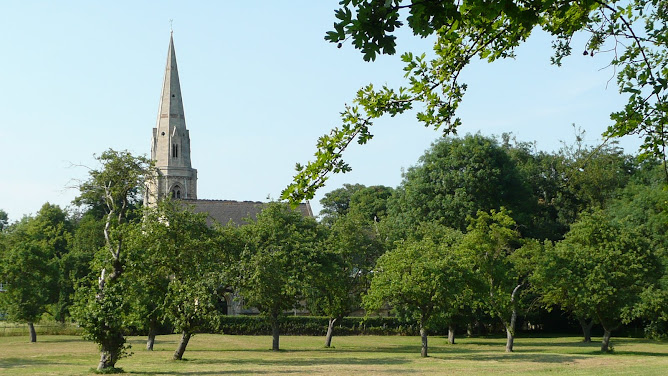
Designed by Sir Gilbert Scott in 14th-century style, and built of Ancaster stone, it is one of the most sumptious modern churches in all Lincolnshire, with a tower and spire 130 feet high, and a porch with niched figures of the Madonna and Child, St Peter, and St Paul, John the Baptist, and John the Evangelist.  The interior is dignified by an arcade on rich clustered columns, but is chiefly notable for the richness of decoration in carving, painting, and windows.  The heads of Peter, Paul, and of Our Lord are in niches on the lovely pulpit of stone and marble, and the alabaster reredos (by Italian craftsmen) shows under three gilded arches Christ carrying the Cross, with an angry man about to strike Him and a Roman sildier on a rearing horse behind; the Crucifixion, with the three women and the disciples; and the Entombment, with Mary Magdelene kneeling.  On each side of the reredos the wall is arcaded, the arches being filled with engraved figures of Apostles, Evangelists, Martyrs and Saints.

Elsewhere the walls are adorned with sacred subjects.  In the chancel are canopied paintings of Apostles and Evangelists, each with his symbol, and over the chancel arch Christ appears in Glory, with a great company of kneeling angels and saints.  More unusual are the paintings on the west wall of the nave - graphic illustrations of the Israelites entering the Promised Land, the Egyptians drowning in the Red Sea, and Noah with his family and the animals going into the Ark two by two, goats, asses, rabbits and snakes among them.

The windows form another fine gallery of pictures.  The east window has a central figure of St Michael with angels and a great multitude of men, women, and children round him; and 24 Elders below, casting their crowns before the Throne.  One of the side windows of the nave has figures of St Hugh of Lincoln and St Theodore, and a second has Oswald and Etheldreda.  A third window, showing St Aidan with the stag and the Venerable Bede writing, is a memorial to a descendent of William Brewster, one of the Pilgrim Fathers, and has smaller scenes depicting sunrise and sunset at sea and the Mayflower sailing the ocean.

The fine west window of the nave, with four scenes showing the gift of Isaac to Sarah, and four more of the gift of Samuel to Hannah, was the work of Clayton and Bell and is a memorial to the Countess of Ripon the builder of this church who died in 1867.

Among the monuments set up in memory of members of her family three are specially notable.  The first is of white marble with an urn to her father, Robert Hobart, the fourth Earl of Buckingham, Secretary of State for the Colonies in the first years of the 19th century and the man after whom the capital of Tasmania is named.  The second is to her uncle, Henry Lewis Hobart, vicar of this church for 33 years and Dean of Windsor as well - a white marble memorial with two kneeling women and cherubs above.  The third is the monument she raised to her husband, the first Earl of Ripon; it is under an arch between chancel and chapel, a stately altar tomb of Carrara marble bearing a figure of the Prime Minister in a long robe, his hands folded, his fine features in repose - a beautiful sculpture by Matthew Noble, the Yorkshireman who gave Liverpool, Manchester and London many fine statues.

The oldest memorial, and the only relic of the old church, is a pompous 17th-century array of marble columns, sculptured urn, helmet, shield, and Latin inscription; it is to Sir William Ellys, who built anew the Hall that Thomas Wymbish had erected in 1530, and which was visited by Hentry VIII and his fifth Queen, Katherine Howard.  Here she came with the ruthless king on a journey which was to end in charges which sent her, still a girl, to join her cousin Anne Boleyn in the chapel of death at the Tower.

Fire destroyed the old Hall in 1834, and the foundation stone of the new (handsome with mullioned windows, tall gables and chimneys, and terrace leading down to a lawn) was laid by Viscount Goderich's 14-year-old son, who was born in the most famous house in England (10 Downing Street) during his father's premiership.  He was to be for forty years associated with Gladstone.  Later in life, when he had become first Marquis of Ripon, and a Roman Catholic, he sold the Nocton estate.  He died in 1909 at his Yorkshire home, Studley Royal, and was buried there in a modern church even more sumptious than the one raised in his father's memory here.

Many fine trees surround the Hall, a veteran among them being a chestnut with a girth of about 35 feet and its great branches borne by a company of props."

Source: The Kings of England - Lincolnshire (1949) - P278/280
____________________________________

Tuesday, 29 May 2007

All Saints Church, Nocton (Part 1)

Early history

Drafted by Charles Kightly (May 1991)

All Saints Church, Nocton [South side] - 30 Jun 2009 
copyright Geoff Hall
Built as 'a monument of affection, erected by a Noble widow in memory of a Noble husband', All Saints at Nocton is perhaps the best and least altered example of a Victorian Gothic church in Lincolnshire. Present-day Nocton is likewise essentially a Victorian planned estate village, the creation of the Hobart and Robinson families of Nocton Hall.

A church and a village, however, existed at Nocton many centuries before Victoria's reign. The original settlement may date from Prehistoric or Roman times: for the Roman Carr Dyke (which linked the river Witham to the Welland and formed part of an ancient fen drainage system), cuts through the middle of the parish, dividing Nocton Fen from the higher land on which the village stands. Two dug-out canoes, probably Bronze Age, were discovered when the Dyke was dredged in 1790. Certainly there was an Anglo-Saxon settlement at Nocton, whose name (spelled 'Nochetune' in 1086) may be derived from the Anglo-Saxon words 'hnoc tun', meaning 'village of the wether sheep'. (A wether is a castrated ram, often kept in ancient times as a flock leader).

When Domesday Book was compiled in 1086, Nocton's population numbered some 38 families, and the village already possessed a priest and a church. (No trace of this Saxon church survives, but it probably stood immediately south-west of Nocton Hall). By this time the manor of Nocton belonged to Norman d'Arcy, one of the companions of William the Conqueror: his descendants would continue to own it for nearly another six centuries, until 1660.

Another important influence on the mediaeval village was Nocton Park Priory, founded by Norman's son Robert d'Arcy in the mid-12th century for the 'Black Canons' of the Augustinian order, so called from the colour of their robes. The Priory stood by the Carr Dyke about a mile east of the village, on a site now known as Abbey Hill. Only earthworks now survive there to mark its position, but in the 18th century the foundations of the Priory church and cloister could still be traced. The canons also owned the parish churches of Nocton and Dunston and land in many surrounding villages, but the Priory was never very large or wealthy, being overshadowed by the more important monasteries of Bardney and Kirkstead. Only four canons were still living there when it was finally suppressed in 1536, during the early stages of Henry VIII's Dissolution of the Monasteries.

On the 13th of October 1541 King Henry VIII himself visited Nocton with his flighty fifth wife Katherine Howard, staying overnight with the young squire Thomas Wymbishe on their return from a royal progress through Yorkshire and Lincolnshire. He is said to have planted an ancient chestnut tree in the Hall grounds. (Not long afterwards Queen Katherine lost her head, partly because of her infidelities during this very progress). The manor house where the royal couple stayed has long since disappeared, along with its successor on the site of the Priory, and by the 1670s ownership of Nocton had passed from the descendants of Norman d'Arcy to the Ellys family.

The first of the family to live at Nocton was the Puritan judge and M.P. Sir William Ellys, whose splendid monument (brought from the old church) can still be seen in the tower of All Saints. Though he held high office as solicitor-general to Oliver Cromwell, he afterwards managed to make his peace with Charles II, and died a wealthy old bachelor in 1680, leaving Nocton to his great-nephew Sir William Ellys, baronet (1653-1727). It was this second Sir William who, in about 1690, built 'the magnificent seat of Nocton Hall', on the site of the present Hall. His mansion (later known as 'the Old Hall') burnt down in 1834, but a fragment of its separate banquetting hall (c.1680 ?) still survives, forming the wall of a house about 100 yards north of the church. Old engravings show that the Old Hall was a large E-plan building, with five turrets topped by cupolas.

Later residents of the Old Hall included the rakish Sir Francis Dashwood. second husband of Sir William's daughter-in-law: nationally notorious as the founder of the 'Hellfire Club', Sir Francis was better-known locally as the public-spirited builder of Dunston Pillar, whose remains still stand by the main A15 road some four miles west of Nocton. Originally 92 feet high, equipped with refreshment rooms, and topped by a lantern, it was designed as a 'land-lighthouse' to guide benighted travellers across the highwayman-haunted wilds of Nocton Heath.

The Hobarts


From the Dashwoods, Nocton passed (in about 1767) to the scarcely less flamboyant George Hobart (1731-1804), later (1793) third Earl of Buckinghamshire. A distant cousin of the Ellys family, Hobart was 'exceedingly fond of dramatics, and was for a time a conductor of the operatic entertainments in London': indeed, he celebrated his arrival at Nocton Hall with 'a grand masquerade', and frequently performed plays there in subsequent years. His wife Albinia Bertie of Branston (1738-1816), was a compulsive gambler and devotee of the game of 'faro'. "When she won, she went abroad in her sedan chair, attended by gorgeous lackeys, to scatter largess among the poor': but when she lost, the Nocton estate had to be temporarily mortgaged (1786) to pay her gambling debts.

Perhaps because of such goings-on, the Hobarts thought the ancient parish church of St. Peter 'too inconveniently close to their mansion'. Though they had no legal right to do so, they therefore demolished it in 1773. Only the Ellys monument and a mediaeval font in All Saints' churchyard now survive from the old church, but the site of its churchyard is marked by a rise in the ground south-west of the present Hall, covering the remains of over 20 generations of Nocton parishioners.

To replace it, the Hobarts built an entirely new Georgian church much further from the Hall, on the site of the present church. Later described as 'a small mean structure', it was consecrated in 1775, and old pictures (there is a drawing in All Saints, and a representation in the north-west window of the nave) show that it was built in the currently fashionable Classical style, with a small bell-turret. The interior was filled with unvarnished deal box-pews, and had a raised gallery at the east end.

The third Earl also drastically 'improved' the Nocton estate, draining its fens and enclosing its common land. Most of his time, however, was spent in 'smart London society', his two sons Robert and Henry being left at Nocton in the care of Katherine ('Nanny') Field, the steward's wife. A touching memorial to her can be seen in All Saints' vestry: it was erected by Henry Hobart 'in full recollection of her Kindness, Care and watchful Attention over him during the first ten years of his life'.

This 'Honourable and Very Reverend Henry Hobart' (1774-1846), whose own much more elaborate monument stands near All Saints' entrance door, was the third Earl's younger son. Appointed Vicar of Nocton in 1815, in the following year he also became Dean of Windsor. He was thus in effect a personal chaplain to the Royal Family, and in his later years this 'strange old gentleman' grossly but quite unintentionally offended the young Queen Victoria: for on the birth of her eldest son (the future King Edward VII) he attempted to congratulate her on 'thus saving us from the incredible curse of a female succession'.

Robert Hobart, the Dean's elder brother, succeeded his father as 4th Earl of Buckinghamshire in 1804: his marble monument stands at the west end of All Saints' nave. It records his career as an eminent politician and colonial administrator, and in particular his negotiation of a new charter (depicted on the monument) for the East India Company. He is now much better known, however, for his associations with Hobart, capital of Tasmania, founded during his time as Colonial Secretary and named after him.

In 1810 the 4th Earl renovated Dunston Pillar, replacing its crowning lantern with a colossal statue of King George III: a mason named John Willson fell off the pillar to his death while fixing it in position, and is buried in Harmston churchyard beneath the tombstone epitaph: 'He who erected the noble King, is here now laid by Death's sharp sting'.

King George himself was less than delighted to hear that his statue had been set up in such a desolate spot. 'Ah, Lincolnshire', he remarked in disgust, 'all flats, fogs and fens!'. The statue was removed when Dunston Pillar was shortened by the R.A.F. during the second World War: its head and shoulders can now be seen in the grounds of Lincoln Castle.

'Prosperity Robinson' and Lady Sarah


Earl Robert died in 1816 without male heirs, whereupon his title passed to a nephew. But the Nocton estate passed to his only daughter Lady Sarah Albinia Hobart (1793-1867), who had recently married the Honourable Frederick John Robinson (1782-1859), then M.P. for Ripon, later Viscount Goderich of Nocton (1827), and eventually first Earl of Ripon (1833).

Robinson's career as a politician left something to be desired, 'he being not endowed with either capacity or experience....besides being disqualified for vigorous measures by the remissness and timidity of his character". His failings as Chancellor of the Exchequer (1823-7) gained him the mocking nickname' Prosperity Robinson', and though he managed to remain Prime Minister for five chaotic months between August 1827 and January 1828, he was 'singular among Prime Ministers in being the only one who never faced Parliament in that capacity, his Cabinet having been formed so weakly or managed so clumsily that it fell to pieces before the accustomed time of trial arrived'. In short, he was 'perhaps the weakest Premier to whom a Sovereign of England ever intrusted the seals of office.

All the same, Lord Ripon was respected as 'a fair and candid man', and he and Lady Sarah were certainly good friends to Nocton. The village's present attractive appearance, indeed, is largely due to the generosity of this couple and their son the Marquess of Ripon (1827-1909). Between them they built the Almshouses (1833), the School (1869), and the cottages known as the Old Row (1841), the Ripon Row (1870s) and the Ten Row (1878), all in a distinctive 'Gothic Revival' style.

The Ripons also built the present Nocton Hall, now a Residential Home and hospital. Despite the valiant efforts of a brand-new village fire-engine, Sir William Ellys's Old Hall burnt to the ground on July the 15th, 1834, blazing for nearly fifteen hours. At the 'earnest petition' of the villagers who volunteered to cart building materials at their own expense - its replacement was begun in October 1841, the architect being William Shearburn of Dorking, a Nocton-born 'local boy made good' who was the son of the estate joiner, Joseph Shearburn. Old Joseph himself oversaw the building work, which took ten years and cost between £40,000 and £50,000. Much of the walling stone was quarried nearby on Dunston Heath.

Wednesday, 24 January 2007

Nocton Hall - Wymbish

'Old Master'


His nephew and successor, old master Thomas Wymbish was Sheriff of Lincolnshire and Mayor of Lincoln. He was a wealthy man, as by his will he left Nocton to his oldest son, Blankney to his second son, and Metheringham to his third son.

'Young' Thomas


Thomas Wymbish was succeeded by his great grandson, young Thomas Wymbish at the age of nine years, in 1530. While still under age he married Elizabeth Lady Tailboys of Kyme, a baroness in her own right, and a great heiress. On Thursday October 13th 1541, these young people were honoured by a visit from King Henry VIII and his fifth Queen, Katherine Howard who stayed the night at Nocton. Young Thomas had a short life and a merry one and died without issue in 1552. For the following seventeen years, the rents of his estates were set aside to pay his debts.

During the time of Young Thomas at Nocton, the Priory, with all other Monasteries in England whose incomes were under £200 per year, was suppressed by the King, and in 1536 it was dis established and disendowed. The net annual income of the Priory was £43. 3s.8d. for the support of a Prior, four Canons and two poor boys who were being educated at the Priory. The income of the Vicarage was £7.10s.0d. net yearly.

Mary


The estate then passed to Mary, the only child of Thomas Wymbish’s sister, Frances. Mary had married John Townley of Burnley, Lancashire and they had a family of seven sons and seven daughters.