Showing posts with label Nocton Park Priory. Show all posts

Wednesday, 29 November 2017

Red telephone box - Wasps Nest

Refurbishment complete

I refer to my blog dated 11 Oct 2017 and can report the red telephone box at Wasps Nest has now been fully refurbished.

Refurbished telephone box at Wasps Nest
What a super job. It will be interesting to see how this will be used... perhaps it can be used as a source of history relating to Wasps Nest?

Why is it called Wasps Nest?


There are many theories. One story that seems to hold more credence than others was related by an old woman [Granny Clayton] who used to live down Nocton Fen. According to her, the original Wasps Nest was a building that had an outer door from every room to the yard - a bit like the cells of a wasp's nest. It was rumoured to be a haunt of highwaymen in years past, as it provided many alternative escape routes. There was even a priest's hole located in the chimney to provide a convenient hiding place.

The cottages and houses on the fen never had electricity or mains water. The estate management decided not to spend money modernising these buildings, but concentrated on modernising the tied properties in the main villages of Dunston and Nocton. Over time, the fen families were moved into the village properties, leaving many of the fen properties vacant and abandoned. These were then demolished during the 1960's.

The remaining houses near the top of the fen at Wasps Nest were saved from demolition by their comparative good state of repair.

There used to be an active Nocton Fen Social Club at Wasps Nest for the use of the many people who lived down the fen. The Wasp Nest Hall was used just like the other two village halls at Nocton and Dunston. It was finally closed in 1959 due to the reduction in population on the fen.

Nocton Fen Rd, Wasps Nest - with estate access bridge over Carr Dyke

Abbey Hill Cottages, Wasps Nest - footbridge over Carr Dyke


Nocton Park Priory


Just above Wasp Nest is an area known as Abbey Hill containing old ruins [Explorer 272 GR 07736478]. This was an old Priory for Black Canons of the Order of St Augustine - so called from the colour of their robes. There are no ruins above ground, with only the undulations and mounds in the land showing where the foundations are located.

It was Robert D'Arcy who founded the Priory in the Park at Nocton, dedicated to St Mary Magdelene for a Prior and four Canons of the Order of St Augustine. The only remains of it are some large stones, broken hillocks and uneven turf on the rising ground which overlooks Nocton Fen. Some broken pottery was found on the site a few years ago and presented to Lincoln Museum. The ashes of a Mr JH Dennis (who latterly owned the Nocton Estate) are scattered in a small fenced enclosure on the site.

There is an eight page ‘Information Sheet’ published by Lincolnshire County Council: Lincolnshire Museums. It was written and compiled by Timothy Ambrose, City and County Museum, Lincoln - July 1979. The sheet is titled ‘Nocton Park Priory’ and is referenced: Archaeology Series No. 15.

There was a searchlight battery stationed on the Abbey Hill during the 2nd World War, owing to the number of important bomber airfields located nearby. There was even a dummy airfield laid out at Partridge Farm on the fen, consisting of reflectors and lights, which were switched on to confuse enemy fighters when they were in the area.

Sources:
  1. Nocton: The Last Years of an Estate Village Vol 1 - by Sheila Redshaw and Sue Morris
  2. A Lincolnshire Lad Looks Back - by Len Woodhead
  3. Historic England
  4. Lincolnshire County Council - Information Sheet Archaeology Series No.15 - Nocton Park Priory

Sunday, 5 February 2017

Beeswax Dyson Farming - latest developments

Construction of new Farm Operations Centre

I refer to my earlier blogs regarding this facility:
I decided to have a walk around the site on Friday with my wife and two Jack Russells and discovered to my surprise that the construction is now out of the ground, with new steelwork being erected.

My first thoughts were 'my goodness that is huge', but having wandered around the periphery of the site on the public footpath, actually the agricultural buildings have been well located I think. You may think otherwise, but the following photographs will give you an idea of the position and dimensions involved.

Plate 1 - View from gates
[nr Nocton Wood House]

Plate 2 - View from public footpath
[adjacent to Nocton Wood]

Plate 3 - View from footpath
[headed towards Wasp's Nest]

Plate 4 - View from end of footpath
[before descending to Wasp's Nest]
Wandering along Nocton Fen Rd, away from the site and looking back towards Abbey Hill and Nocton Wood, I was pleased to observe that the building ridge line sits below the crown of the tree-scape beyond, which will allow the operations centre to blend in with the landscape. The historic site of Nocton Priory will not be visually contaminated at all - in any case the foundations remaining are simply mounds on Abbey Hill.

Plate 5 - View from Wasp's Nest
[Nocton Wood peeping over the horizon]

Plate 6 - View from Nocton Fen Rd
[looking up towards Abbey Hill and Nocton Priory]

Plate 7 - View from the top of Nocton Fen Rd
[looking towards Abbey Hill with Nocton Wood in the background]
Once the facility has been completed, perhaps Beeswax Dyson Farming Ltd might offer an educational tour of the new Operations Centre for the local community?

I think it would make for a really interesting visit.

Footnote

The Priory of Nocton Park
  1. http://www.british-history.ac.uk/vch/lincs/vol2/pp168-170
  2. http://www.rodcollins.com/wordpress/nocton-park-priory-in-lincolnshire-history-pictures
  3. https://historicengland.org.uk/listing/the-list/list-entry/1018898

Friday, 30 October 2015

Nocton Hall - stimulating interest

Potential development site

With Leda Properties rumoured to be on the verge of presenting outline plans for development of their long-term investment, I would now like to publish some of the work I have been doing in the background to get some progression on this asset.

1) Time Team Programme

From: Geoff Hall
Sent: 21 April 2012 17:31
To: Time Team
Subject: Nocton Park Priory & Nocton Hall

Good afternoon,

I would like to suggest a site visit by the Time team to the village and surrounds of Nocton in Lincolnshire.

Possible Objectives
  •  Determine the exact layout of Nocton Park Priory
  •  Confirm that the Priory was not actually converted/rebuilt into a Manor House on the same site
  •  Confirm that the stone from the Priory was robbed out and used to construct the Nocton Old Hall (in the heart of the village)
  •  Confirm the site of the remains of St Peter’s Church to the west of the current Grade II Listed Nocton Hall
Background History

One document is enclosed for perusal:
Location
  • Nocton Park Priory – OS Explorer 272 [South Sheet] GR078648 (1:25000) 
  • Nocton Hall – OS Explorer 272 [South Sheet] GR06156435 (1:25000) 
  • Aerial View – Nocton Hall 53.165594, -0.413564; Nocton Park Priory remains clearly shown on mound in corner of Nocton Fen Lane, Wasp’s Nest 53.169466, -0.389457
My interest
  • I have been interested in the history of Nocton since retiring to the village in 2005. I have made contact with many of the residents who have a similar mind set, some who have actively collected much information over the years. 
  • I have created a village blog which has archived much of the material relating to Nocton Hall, the village and the Estate for the benefit of others. 
  • The village is actively trying to save the remains of the Grade II Listed Nocton Hall from further deterioration
Ownership of Land
  • Nocton Park Priory – Nocton Dairies Ltd 
  • Nocton Hall – Leda Properties Ltd
Yours sincerely,
Geoff Hall

From: Time Team
Sent: Tuesday, April 24, 2012 12:33 PM
To: Geoff Hall
Subject: RE: Nocton Park Priory & Nocton Hall

Dear Geoff,

Many thanks for writing to us with a site suggestion.  We are currently working on the 2012 series of Time Team and are on the lookout for good sites. I will discuss your suggestion with the series director and if we’d like to pursue then we’ll be in touch later in the year.

If you haven’t heard from us by May I’m afraid it means the site hasn’t made the shortlist. I’m sure you’ll understand that we receive hundreds of suggestions each year, but all are considered!

We do appreciate you contacting us,

Regards,
Development Producer
Time Team

2) HILT Foundation

From: Geoff Hall
Sent: Monday, July 8, 2013 11:59 AM
To: HILT Foundation
Subject: Nocton Hall

Good morning,

It was good to meet you at the Air Show yesterday. Although it appears you are in the very early stages of talking to the owners of the RAF Hospital site in Nocton (Leda Properties), as a matter of courtesy I am providing a link to the Nocton in Lincolnshire blog. This contains quite a bit of background information about the development site if you scroll down to the bottom of the page and use one of the shortcuts to ‘Nocton Hall’ or ‘RAF Nocton Hall’.

If your organisation manages to make progress with any plans for a solar farm in Nocton, I would be happy to provide any updates to the community through this blog if you feel it worthwhile.

I wish you every success with your business.

Best regards,
Geoff

From: HILT Foundation
Sent: Monday, July 8, 2013 1:05 PM
To: Geoff Hall
Subject: Re: Nocton Hall

Geoff,

Many thanks for that, and would appreciate you staying on board providing info like this. Pleasure to have met you at the show.

Kindest regards
HILT Foundation

3) Gladman Developments

From: Geoff Hall
Sent: 08 December 2014 13:07
To: Gladman Developments
Subject: Potential site for development

Dear Sir/Madam,

I am a local resident of the village of Nocton in Lincolnshire and would like to bring to your attention a parcel of land that could be ripe for an exciting development.

Location of site

Nocton in the North Kesteven District of Lincolnshire - seven miles south-east of Lincoln (an up and coming University city).

Background

The land concerned is at the heart of our village and consists of a Grade II listed property (Nocton Hall – a partial ruin), associated woodland and grounds, together with a decommissioned RAF Hospital site (which could be an enabling-venture for the stabilisation/development of the old hall and pleasure grounds). The land is currently in the ownership of Leda Properties Ltd, Marcham Road, Abingdon, Oxon, OX14 1TZ. There was an initial plan (Planning Application: N/42/1268/02) which unfortunately never came to fruition, since then the site has been allowed to fall into disrepair.

North Kesteven District Council have commissioned an Options Appraisal in partnership with English Heritage, which concentrates on the constraints of redevelopment for the old hall. You may also like to see the Project Viability Report that supports the Options Appraisal - I believe Option 3 was the preferred solution.

The local Parish Council has recently published a resolution on the lack of progress with this site and you may like to conclude with reading my last village blog regarding the situation with this site.

Why you?

Your company appear to be action-oriented, not afraid of speculative acquisitions and are content to take calculated risks with development. You are also involved in developing a mix of property - office, industrial and residential. Your company also has an ethos of working in partnership (this being very important to our community too), and you are persistent with seeking resolution to your plans.

Finally, I do not require a response to this email - it is purely for information.

Yours faithfully,
GM Hall

From: Gladman Developments
Sent: 22 December 2014 16:42
To: Geoff Hall
Subject: Gladman Land Enquiry

Dear G M Hall,

Thank you for considering Gladman with regards to Nocton Hall, Lincolnshire. Gladman specialise in obtaining consent on sustainable sites of 7 acres and above, adjacent to existing settlements.

The redevelopment of a listed building therefore would not be something we would pursue but once again many thanks for providing us with the opportunity to assess the hall.

Kind Regards
Gladman Developments


4) Retirement Villages

From: Geoff Hall
Sent: 08 December 2014 19:13
To: Retirement Villages
Subject: Potential land for development

Dear Sir/Madam,

I am a local resident of the village of Nocton in Lincolnshire and would like to bring to your attention a parcel of land that could be ripe for an exciting retirement development.

Location of site

Nocton in the North Kesteven District of Lincolnshire - seven miles south-east of Lincoln (an up and coming University city).

Background

The land concerned is at the heart of our village and consists of a Grade II listed property (Nocton Hall – a partial ruin), associated woodland and grounds, together with a decommissioned RAF Hospital site (which could be an enabling-venture for the stabilisation/development of the old hall and pleasure grounds). The land is currently in the ownership of Leda Properties Ltd, Marcham Road, Abingdon, Oxon, OX14 1TZ. There was an initial plan (Planning Application: N/42/1268/02) which unfortunately never came to fruition, since then the site has been allowed to fall into disrepair.

North Kesteven District Council have commissioned an Options Appraisal in partnership with English Heritage, which concentrates on the constraints of redevelopment for the old hall. You may also like to see the Project Viability Report that supports the Options Appraisal - I believe Option 3 was the preferred solution.

The local Parish Council has recently published a resolution on the lack of progress with this site and you may like to conclude with reading my last village blog regarding the situation with this site.

Why you?

The fact that your company has been shortlisted for a national property award demonstrates the value placed on the design of your developments.  There are clearly a number of heritage properties that have been sensitively developed too.  Your developments maximise the beautiful surroundings in which they are based. Your company is one of the longest established operator of care villages in the UK and therefore should be well placed to see the long-term value of this village site.
Finally, I do not require a response to this email - it is purely for information.

Yours faithfully,
GM Hall

5) Jackson & Jackson Developments

From: Geoff Hall
Sent: 05 August 2015 09:08
To: Globe Limited
Subject: Potential Development Site - Nocton

Dear Sir/Madam,

I see you are acting for Cameron and Dominik Jackson [Jackson and Jackson Developments Ltd] regarding ‘The Parklands’ at Sudbrooke.  I have seen the article in the Lincolnite and it seems a very innovative development.

I would like to bring Cameron and Dominik’s attention to an undeveloped brownfield site that is at the heart of our village in Nocton.  If they are seeking further potential development sites around the Lincoln area, it could make an exciting project for those with a vision to make it succeed.

Site Details

This contains a ruin of a Grade II Listed property (Nocton Hall) and a decommissioned RAF Hospital consisting of many tumbledown prefabricated buildings. A property investment company (Leda Properties) originally paid in excess of £300K for RAF Nocton Hospital (as reported in the Lincolnshire Echo on 8th January 2000).  Leda Properties originally submitted plans to North Kesteven District Council back in 2002 (1267/02 and 1268/02), but these were refused.  I believe the over-riding concern at the time was the number of properties projected for the site, in what was then a 3rd tier village.

Since then, despite the efforts of North Kesteven District Council to seek a satisfactory resolution with Leda Properties, the site has continued to deteriorate and remains undeveloped.  The local Parish Council is also frustrated by the lack of progress with this site.  The last action of any merit was the preparation of an Options Appraisal to guide any development work.

Options Appraisal

The costs of a full renovation of Nocton Hall would probably be too prohibitive, as any developer would be unlikely to cover the costs by the sale of the renovation, even if it were to be converted into luxury apartments, a hotel facility or something similar.  It would require an extensive ‘enabling development’ on the RAF Hospital site.

Option Appraisal costings – solely for Nocton Hall [October 2011]

1. Total demolition - £0.327m
2. Historic ruin - £0.932m
3. Partial demolition - £1.947m
4. Repair as ruin and develop Service Wing - £2.355m
5. Full restoration - £7.845m

Although Nocton Hall is now a shadow of its former self, there are parts of the building that would be easier to renovate e.g. the service wing.  That is probably why NKDC selected their preferred option of stabilising Nocton Hall as a ruin and developing the service wing (circa £2.355 million)… and reducing the number of properties within the ‘enabling development’.

N.B. any proposals would need to reflect the historic setting and grounds – some of the demolition options would not be acceptable to English Heritage.  There is also  a rumoured MOD claw-back of 50% on any developer profits made (which expires in approximately 2022) – this may explain why no agreement has ever been reached between Leda and NKDC, as there could be a tension over the number of properties to be incorporated in any ‘enabling development’.

As you can see there are many unknowns with this site and it would require careful research, but I truly believe there is an exciting possibility awaiting the right developer, if the potential hurdles could be overcome.  I suppose it will always come down to money and whether the potential profits make taking the risks involved worthwhile, which will dependent on:
  • How many properties are permitted to be constructed on the RAF Hospital site by the planning authority as an ‘enabling development’, and
  • How much (or how little) profit will be acceptable to the developers and owners of the site.
Finally, I am not aware that Leda Properties actually develop their sites themselves, as a property investment company I think they tend to work in partnership with other developers to share the profit outcomes. I would like to think that a sympathetic developer might sometime approach Leda to purchase the land, after approaching NKDC to see what the limitations would be for the site.

Thank you for taking the time to read this email – there is no need to reply – it is purely for information.

Yours sincerely,
Geoff Hall
Nocton in Lincolnshire

N.B. Along with the links provided, a great deal of background information about Nocton Hall can be obtained through the ‘Search’ facility or ‘Index’ on my local blog.
http://nocton.blogspot.co.uk/2014/02/nocton-hall.html
http://www.nocton.blogspot.co.uk/2014/10/compulsory-purchase-order.html
http://www.sleafordstandard.co.uk/news/local/delays-to-repair-of-nocton-hall-are-intolerable-1-6322865
http://www.lincolnshireecho.co.uk/Nocton-Hall-10-endangered-buildings/story-11199073-detail/story.html
http://www.ledaproperties-abingdon.co.uk/

Meet the brothers behind a multi-million pound company championing change in Lincoln

http://www.lincolnshireecho.co.uk/Meet-brothers-multi-million-pound-company/story-28127151-detail/story.html

6) Landmark Trust

From: Geoff Hall
Sent: 27 October 2015 08:39
To: Landmark Trust
Subject: Nocton Hall

Good morning,

I have been enjoying your recent television programme about the activities of the Landmark Trust and would like to bring to your attention a Grade II Listed building at the heart of our village which has an interested history.

The local Parish Council and North Kesteven District Council have worked hard over the years to find a solution to halt the decline of this once cherished building and an Options Appraisal was produced in partnership with English Heritage.

It appears at long last that the owners are due to present outline plans for an enabling development that will be built in the grounds of the Hall, which includes an old RAF Hospital site. The stabilisation and renovation of Nocton Hall, as outlined in the Options Appraisal will be conditional.

I am highlighting this property to you at this early stage, as there could be an opportunity for you to assist in saving part of the Hall. This of course would have to be in partnership with the various bodies... and that perhaps you could get some return from some of the refurbished Hall being rented out as holiday accommodation in a historical village setting.

Regards,
Geoff
http://www.nocton.blogspot.co.uk/

From: Landmark Trust
Sent: 28 October 2015 10:47
To: Geoff Hall
Subject: Nocton Hall

Dear Geoff

Thanks for getting in touch about Nocton Hall. It’s good to see proactive plans are being drawn up to save the house, but I think it’s not one for Landmark. We very rarely share mixed use sites (and usually have just one unit of Landmark accommodation per site). In addition, once a commercial developer is involved, sites rarely ‘need’ Landmark’s help. We get well over 100 approaches about potential buildings a year, or which we can only take on 2-3, so we have to reserve our efforts for those buildings that really won’t survive without us.

Sorry we can’t help,

Best wishes
Landmark Trust

My conclusion


I think the lack of development to date demonstrates the potential difficulties with this site and particularly whether the whole matter can prove profitable for those likely to be involved.
Sunday, 27 January 2013

Country Homes

Nocton Hall, Lincoln - The Seat of Mr. J. Hodgson

"Those who know the charm of great over-arching skies and far-distant prospects melting at sunset into the gold and purple west, will not under-value such a characteristic land, even though when the night falls, and they draw their casement curtains, they glance, like Mariana, only 'athwart the glooming flats'." Such describes the fen-land of Lincolnshire.

During my research, I have discovered a number of images of Nocton Hall that seem to have illustrated an old Country Life magazine. I have since managed to locate the article concerned, which was originally published on 28 September 1901. It was tracked down to the archives of IPC Media Ltd. Copyright permission has kindly been granted by the Picture Library Manager, in order for me to reproduce the article for you to read. I do hope you find it of interest.

Country Homes - Gardens: Old & New

Tuesday, 17 January 2012

'The Nine Brethren'

Ancient Boundary Marker

'The Nine Brethren' is a remarkable tree which is situated deep within Nocton Wood, otherwise known locally as 'The Big Wood'. It is rumoured to be an ancient boundary marker separating the Lord of the Manor's land and that belonging to the old Augustinian Priory founded by Robert D'Arcy, the ruins of which are situated on Abbey Hill overlooking Nocton Fen and Wasp's Nest.

The tree was named 'The Nine Brethren' because of its unusual shape - the bole has divided into nine separate trunks allowing people to stand within its centre.

Cataloguing Sheila Redshaw's extensive archive of material, I came across an old map which identified the exact location of  'The Nine Brethren', together with an image showing what it looked like. This has prompted me to seek out this wonderful specimen to record it once again for posterity in 2012.

You may be interested to know that North Kesteven District Council classify Nocton Wood as:

'An outstanding wildlife site, and the central part of a complex of woodlands in this part of the District that are of County importance. It is also one of the largest woodland blocks in the District. The woodland type varies from high forest to coppice, and the shrub layer is rich. The soil is sandy and the ground flora is therefore quite different to the other woods in the area. The wood is an important bird habitat and, in overall terms, is one of the finest non-SSSI woodlands in Lincolnshire.'

You might have noticed logging lorries going through the village recently, transporting large amounts of timber and wondered where these were coming from. There is extensive maintenance work going on in Nocton Wood and I understand this is the source of the timber.

If you wish to read more about 'The D'Arcys' here is a blog entry posted back in 2007.

Plate 1: 'The Nine Brethren' in January 2012 [inset is a picture taken many years ago - I believe it was taken in Winter 1973].
Plate 2 and 3: these two images give better detail of this distinctive tree.


Plate 1. 'The Nine Brethren'
Plate 2. 'The Nine Brethren'
Plate 3. 'The Nine Brethren'

Friday, 23 December 2011

Merry Christmas

A curse on it?

Nocton Hall - now an RAF Hospital - has a long history, though the present building goes back only to the year 1841. It replaced an older hall which was destroyed by fire in 1834. And this older building, it is said, was constructed from the stones of the ancient Nocton Park Priory - hence a curse which was laid upon the Hall, that it would never be in the possession of one family for more than three generations.

It is a fact that it never has been occupied by one family for more than three generations!

 [Lincolnshire Echo - 13 June 1962]

As 2011 almost comes to an end, may I wish all my readers and friends a very Merry Christmas and Happy New Year.

To use a quote from one of my favourite comedians, Dave Allen: "Goodnight, thank you, and may your God go with you".

Saturday, 10 September 2011

Nocton Hall - Revelations of an Imp - Chapter 5

The last days of Nocton Priory

By 1535, King Henry's bank statement showed he was deeply in debt. This situation called for drastic measures to put his Royal account into credit. On the advice of those who kept the money supply topped up, it was suggested that the Religious Houses throughout his realm, might provide a flush of funds to meet the Court's expenditure. An order was issued that any Monastery with an income of less than £200 per annum, should be closed and both buildings and land transferred to the Crown. Nocton Priory, even after Sir Nicholas Wymbishe's skill in stabilizing their financial position, fell far short of the Royal limit. Young Sir Thomas Wymbishe shared the deep feelings and sadness of the Prior and Canons. There was no way to save their Religious House, established over 400 years through the original generosity of Robert D'Arcy. It had become complimentary to Nocton Hall. Its way of life harmonised with the village and above all, the quality of the honey, for its medicinal value, was the envy of the Lincolnshire countryside.

Sir Thomas, acting in a most vigorous manner, did what he could and although after his death he was criticised as a 'big spender', no one gave credit for the young man's generosity and help in acquiring a 'golden handshake' for the Prior, and others of their religious order, living at the Priory on the 'day of doom'.

The fortunate gentleman, to receive the gift of the Priory and 300 acres estate, was none other than Charles Brandon, Duke of Suffolk. He lived a further 10 years as the proud owner of this small and re-styled ducal establishment. In accordance with the King's wish, any building suitable for worship, was destroyed, but Charles Brandon, with the persuasion of his fourth wife, Katherine Willoughby, converted what remained of the Priory into a comfortable home, well sheltered with fine trees and giving the house an open view across the Roman Car Dyke to Nocton Fen, in the direction of Bardney.

It is possible that both the Duke's sons, Henry and Charles were born in his Nocton home, but during their education at St. John's College, Cambridge, the two brothers became seriously ill and were taken to the Bishop of Lincoln's home at Buckden in Huntingdonshire where they died (Mary, the former wife of Charles Brandon was the King's sister and widow of the King of France).
________________________________________________________________________________

Tuesday, 29 May 2007

All Saints Church, Nocton (Part 1)

Early history

Drafted by Charles Kightly (May 1991)

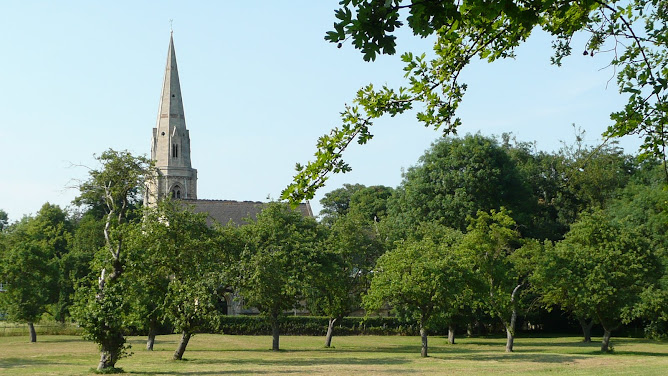
All Saints Church, Nocton [South side] - 30 Jun 2009 
copyright Geoff Hall
Built as 'a monument of affection, erected by a Noble widow in memory of a Noble husband', All Saints at Nocton is perhaps the best and least altered example of a Victorian Gothic church in Lincolnshire. Present-day Nocton is likewise essentially a Victorian planned estate village, the creation of the Hobart and Robinson families of Nocton Hall.

A church and a village, however, existed at Nocton many centuries before Victoria's reign. The original settlement may date from Prehistoric or Roman times: for the Roman Carr Dyke (which linked the river Witham to the Welland and formed part of an ancient fen drainage system), cuts through the middle of the parish, dividing Nocton Fen from the higher land on which the village stands. Two dug-out canoes, probably Bronze Age, were discovered when the Dyke was dredged in 1790. Certainly there was an Anglo-Saxon settlement at Nocton, whose name (spelled 'Nochetune' in 1086) may be derived from the Anglo-Saxon words 'hnoc tun', meaning 'village of the wether sheep'. (A wether is a castrated ram, often kept in ancient times as a flock leader).

When Domesday Book was compiled in 1086, Nocton's population numbered some 38 families, and the village already possessed a priest and a church. (No trace of this Saxon church survives, but it probably stood immediately south-west of Nocton Hall). By this time the manor of Nocton belonged to Norman d'Arcy, one of the companions of William the Conqueror: his descendants would continue to own it for nearly another six centuries, until 1660.

Another important influence on the mediaeval village was Nocton Park Priory, founded by Norman's son Robert d'Arcy in the mid-12th century for the 'Black Canons' of the Augustinian order, so called from the colour of their robes. The Priory stood by the Carr Dyke about a mile east of the village, on a site now known as Abbey Hill. Only earthworks now survive there to mark its position, but in the 18th century the foundations of the Priory church and cloister could still be traced. The canons also owned the parish churches of Nocton and Dunston and land in many surrounding villages, but the Priory was never very large or wealthy, being overshadowed by the more important monasteries of Bardney and Kirkstead. Only four canons were still living there when it was finally suppressed in 1536, during the early stages of Henry VIII's Dissolution of the Monasteries.

On the 13th of October 1541 King Henry VIII himself visited Nocton with his flighty fifth wife Katherine Howard, staying overnight with the young squire Thomas Wymbishe on their return from a royal progress through Yorkshire and Lincolnshire. He is said to have planted an ancient chestnut tree in the Hall grounds. (Not long afterwards Queen Katherine lost her head, partly because of her infidelities during this very progress). The manor house where the royal couple stayed has long since disappeared, along with its successor on the site of the Priory, and by the 1670s ownership of Nocton had passed from the descendants of Norman d'Arcy to the Ellys family.

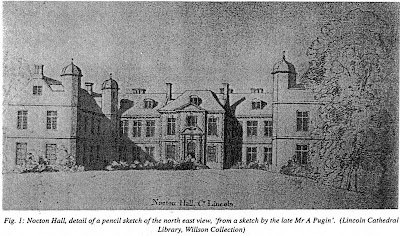
The first of the family to live at Nocton was the Puritan judge and M.P. Sir William Ellys, whose splendid monument (brought from the old church) can still be seen in the tower of All Saints. Though he held high office as solicitor-general to Oliver Cromwell, he afterwards managed to make his peace with Charles II, and died a wealthy old bachelor in 1680, leaving Nocton to his great-nephew Sir William Ellys, baronet (1653-1727). It was this second Sir William who, in about 1690, built 'the magnificent seat of Nocton Hall', on the site of the present Hall. His mansion (later known as 'the Old Hall') burnt down in 1834, but a fragment of its separate banquetting hall (c.1680 ?) still survives, forming the wall of a house about 100 yards north of the church. Old engravings show that the Old Hall was a large E-plan building, with five turrets topped by cupolas.

Later residents of the Old Hall included the rakish Sir Francis Dashwood. second husband of Sir William's daughter-in-law: nationally notorious as the founder of the 'Hellfire Club', Sir Francis was better-known locally as the public-spirited builder of Dunston Pillar, whose remains still stand by the main A15 road some four miles west of Nocton. Originally 92 feet high, equipped with refreshment rooms, and topped by a lantern, it was designed as a 'land-lighthouse' to guide benighted travellers across the highwayman-haunted wilds of Nocton Heath.

The Hobarts


From the Dashwoods, Nocton passed (in about 1767) to the scarcely less flamboyant George Hobart (1731-1804), later (1793) third Earl of Buckinghamshire. A distant cousin of the Ellys family, Hobart was 'exceedingly fond of dramatics, and was for a time a conductor of the operatic entertainments in London': indeed, he celebrated his arrival at Nocton Hall with 'a grand masquerade', and frequently performed plays there in subsequent years. His wife Albinia Bertie of Branston (1738-1816), was a compulsive gambler and devotee of the game of 'faro'. "When she won, she went abroad in her sedan chair, attended by gorgeous lackeys, to scatter largess among the poor': but when she lost, the Nocton estate had to be temporarily mortgaged (1786) to pay her gambling debts.

Perhaps because of such goings-on, the Hobarts thought the ancient parish church of St. Peter 'too inconveniently close to their mansion'. Though they had no legal right to do so, they therefore demolished it in 1773. Only the Ellys monument and a mediaeval font in All Saints' churchyard now survive from the old church, but the site of its churchyard is marked by a rise in the ground south-west of the present Hall, covering the remains of over 20 generations of Nocton parishioners.

To replace it, the Hobarts built an entirely new Georgian church much further from the Hall, on the site of the present church. Later described as 'a small mean structure', it was consecrated in 1775, and old pictures (there is a drawing in All Saints, and a representation in the north-west window of the nave) show that it was built in the currently fashionable Classical style, with a small bell-turret. The interior was filled with unvarnished deal box-pews, and had a raised gallery at the east end.

The third Earl also drastically 'improved' the Nocton estate, draining its fens and enclosing its common land. Most of his time, however, was spent in 'smart London society', his two sons Robert and Henry being left at Nocton in the care of Katherine ('Nanny') Field, the steward's wife. A touching memorial to her can be seen in All Saints' vestry: it was erected by Henry Hobart 'in full recollection of her Kindness, Care and watchful Attention over him during the first ten years of his life'.

This 'Honourable and Very Reverend Henry Hobart' (1774-1846), whose own much more elaborate monument stands near All Saints' entrance door, was the third Earl's younger son. Appointed Vicar of Nocton in 1815, in the following year he also became Dean of Windsor. He was thus in effect a personal chaplain to the Royal Family, and in his later years this 'strange old gentleman' grossly but quite unintentionally offended the young Queen Victoria: for on the birth of her eldest son (the future King Edward VII) he attempted to congratulate her on 'thus saving us from the incredible curse of a female succession'.

Robert Hobart, the Dean's elder brother, succeeded his father as 4th Earl of Buckinghamshire in 1804: his marble monument stands at the west end of All Saints' nave. It records his career as an eminent politician and colonial administrator, and in particular his negotiation of a new charter (depicted on the monument) for the East India Company. He is now much better known, however, for his associations with Hobart, capital of Tasmania, founded during his time as Colonial Secretary and named after him.

In 1810 the 4th Earl renovated Dunston Pillar, replacing its crowning lantern with a colossal statue of King George III: a mason named John Willson fell off the pillar to his death while fixing it in position, and is buried in Harmston churchyard beneath the tombstone epitaph: 'He who erected the noble King, is here now laid by Death's sharp sting'.

King George himself was less than delighted to hear that his statue had been set up in such a desolate spot. 'Ah, Lincolnshire', he remarked in disgust, 'all flats, fogs and fens!'. The statue was removed when Dunston Pillar was shortened by the R.A.F. during the second World War: its head and shoulders can now be seen in the grounds of Lincoln Castle.

'Prosperity Robinson' and Lady Sarah


Earl Robert died in 1816 without male heirs, whereupon his title passed to a nephew. But the Nocton estate passed to his only daughter Lady Sarah Albinia Hobart (1793-1867), who had recently married the Honourable Frederick John Robinson (1782-1859), then M.P. for Ripon, later Viscount Goderich of Nocton (1827), and eventually first Earl of Ripon (1833).

Robinson's career as a politician left something to be desired, 'he being not endowed with either capacity or experience....besides being disqualified for vigorous measures by the remissness and timidity of his character". His failings as Chancellor of the Exchequer (1823-7) gained him the mocking nickname' Prosperity Robinson', and though he managed to remain Prime Minister for five chaotic months between August 1827 and January 1828, he was 'singular among Prime Ministers in being the only one who never faced Parliament in that capacity, his Cabinet having been formed so weakly or managed so clumsily that it fell to pieces before the accustomed time of trial arrived'. In short, he was 'perhaps the weakest Premier to whom a Sovereign of England ever intrusted the seals of office.

All the same, Lord Ripon was respected as 'a fair and candid man', and he and Lady Sarah were certainly good friends to Nocton. The village's present attractive appearance, indeed, is largely due to the generosity of this couple and their son the Marquess of Ripon (1827-1909). Between them they built the Almshouses (1833), the School (1869), and the cottages known as the Old Row (1841), the Ripon Row (1870s) and the Ten Row (1878), all in a distinctive 'Gothic Revival' style.

The Ripons also built the present Nocton Hall, now a Residential Home and hospital. Despite the valiant efforts of a brand-new village fire-engine, Sir William Ellys's Old Hall burnt to the ground on July the 15th, 1834, blazing for nearly fifteen hours. At the 'earnest petition' of the villagers who volunteered to cart building materials at their own expense - its replacement was begun in October 1841, the architect being William Shearburn of Dorking, a Nocton-born 'local boy made good' who was the son of the estate joiner, Joseph Shearburn. Old Joseph himself oversaw the building work, which took ten years and cost between £40,000 and £50,000. Much of the walling stone was quarried nearby on Dunston Heath.

Wednesday, 24 January 2007

Nocton Hall - Wymbish

'Old Master'


His nephew and successor, old master Thomas Wymbish was Sheriff of Lincolnshire and Mayor of Lincoln. He was a wealthy man, as by his will he left Nocton to his oldest son, Blankney to his second son, and Metheringham to his third son.

'Young' Thomas


Thomas Wymbish was succeeded by his great grandson, young Thomas Wymbish at the age of nine years, in 1530. While still under age he married Elizabeth Lady Tailboys of Kyme, a baroness in her own right, and a great heiress. On Thursday October 13th 1541, these young people were honoured by a visit from King Henry VIII and his fifth Queen, Katherine Howard who stayed the night at Nocton. Young Thomas had a short life and a merry one and died without issue in 1552. For the following seventeen years, the rents of his estates were set aside to pay his debts.

During the time of Young Thomas at Nocton, the Priory, with all other Monasteries in England whose incomes were under £200 per year, was suppressed by the King, and in 1536 it was dis established and disendowed. The net annual income of the Priory was £43. 3s.8d. for the support of a Prior, four Canons and two poor boys who were being educated at the Priory. The income of the Vicarage was £7.10s.0d. net yearly.

Mary


The estate then passed to Mary, the only child of Thomas Wymbish’s sister, Frances. Mary had married John Townley of Burnley, Lancashire and they had a family of seven sons and seven daughters.

Nocton Hall - D'Arcys

Domesday Book

In 1086, the date of the Domesday Book, the two English owners had given place to a single foreigner, Norman de Adreci, or D'Arcy, one of the companions of William the Conqueror.
N.B: in Domesday, Nocton is spelt "Nochetune" and in later documents, "Noketon" and "Nokton".

In addition to Nocton, D'Arcy was given 32 other parishes in Lincolnshire. The parish must have been of some importance in those days because D'Arcy preferred to live there. The parish numbered 41 households including the Lord of the Manor, the priest, "twenty six sokemen, nine villeins, and three bordars" with nine plough teams and two "talliage"of £2.0s.0d. The value of the manor in 1086 was reckoned at £10.0s.0d.

For eleven generations from circa 1070 to 1350 the D'Arcys held the lordship of Nocton; for twelve more generations from 1350 to 1660 their descendants on the spindle side continued the succession. This family improved the Estate and the Hall, which must have existed in Ulf's time, but apparently no attempt was made to fortify the Hall as no trace of anything in the shape of a castle exists.


Norman D'Arcy's son and successor, Robert D'Arcy, lived in the days of the great monastic revival under Henry I. and Stephen. He gave the churches of Nocton and Dunston to the Benedictine Monks of St Mary's Abbey at York, and granted certain lands at Nocton and Dunston to the Cistercian Monks at Kirkstead Abbey, near Woodhall Spa.

Nocton Park Priory


It was Robert who founded the Priory in the Park at Nocton, dedicated to St Mary Magdelene for a Prior and four Canons of the Order of St Augustine. The Priory stood in what is still known as Abbey Hill and the only remains of it are some large stones, broken hillocks and uneven turf on the rising ground which overlooks Nocton Fen. Some broken pottery was found on the site a few years ago and presented to Lincoln Museum.

N.B: the ashes of a Mr JH Dennis (who latterly owned the Nocton Estate) are scattered in a small fenced enclosure on the site.

The D'Arcys, throughout the ages, were Lords of Parliament, most of them were soldiers, fighting for the King abroad or against the King in several civil wars. One, Norman, in 1215 was one of the barons in arms against King John, from whom they exacted the Great Charter on June 15th. Thomas D'Arcy (who married a d'Eyncourt of Blankney) won a law suit which he brought against the Bishop of Lincoln for appointing a Prior of whom he disapproved.

Nocton Priory - seal
Thomas's son, another Norman D'Arcy lost a law-suit which a Prior brought against him for stopping up a right-of-way from the Priory to the Watermill at Dunston. Prior Lane at Dunston is still in existence, leading from the old mill in the direction of Abbey Field. It probably follows the line of the main drive through Nocton Wood, past the trees now known as the Nine Brethren and the Odd Tree, as it is quite obvious these were, years ago, boundary trees and probably divided the Lord of the manor's land from the Priors.

The importance of the D'Arcy barony must have entitled its holders to a writ of personal summons to the great council of the realm from the earliest days in which these special writs were used to distinguish the barons from the tenants-in-chief of lower rank. We find Norman D'Arcy personally summoned to the Parliament of September 1283, and the status of the Lords of Nocton as hereditary barons by writ was clearly established in the person of his oldest son, Philip, born 1259 who was summoned in like manner to every Parliament held from February 1297 to January 1307.

In 1314 another and graver quarrel arose between the Prior and the Lord. Matters came to such a pass that the Prior addressed to the King's Council a petition setting forth that Philip D'Arcy "keeps in his Manor of Nocton several unknown men who are sworn never to to cease from doing all the damage and injury that they can to the said Prior and his house, and who indeed are constantly from day to day seizing the said Prior's farm-beasts, both plough-oxon and others, and doing divers other injuries; so that for this reason the lands belonging to the said Prior lie untilled and unsown, and for those things the said Prior prays that a remedy be provided him". The Council appointed three justices to examine and decide the case, but unfortunately no exact record can be found of the trial or its result; but one account states that Philip was bound over to keep the peace for twelve months.

This same Philip joined in the revolt of Earl Thomas of Lancaster against the King, and was made prisoner with him at Boroughbridge in 1322. His estates were forfeited, but were restored shortly after the execution of the Earl, and Norman then accompanied Edward III. to his Flemish Wars of 1338-1339.

Philip died on March 25th 1340 and on his death Sir Philip de Lymbury and Agnes, wife of Sir Roger de Pedwardine, relatives through marriage, were declared coheirs of the D'Arcy Estates. From Philip's death to 1444, Nocton is totally without history. To fill the blank we have only the pedigrees showing how the Lymbury share of the estate descended to one, Nicholas Wymbishe. It was during this period that the estate was divided between the coheirs, with some probably sold, thereby reducing the once vast acreage.

During the D'Arcy period several attempts were made to establish a market at Nocton which might have considerably influenced its material well being and social development. In 1214 the second Norman D'Arcy obtained from King John a Charter for himself and his heirs to hold a market at his manor in Nocton "but so that it should not be to the injury of the neighbouring markets". The same Charter included the grant of a warren in the same manor. But the forfeiture of Norman's estates in the winter of 1215-6 probably involved the deprivation of this Charter.

In 1281 his grandson, the third Norman, being summoned to show by what tenure he held his estates, and what "liberties" he claimed in them, thus enumerated his rights at Nocton - free warren, gallows, a market every Tuesday, assize of bread and ale, and all other liberties pertaining to a market, and a fair every year on the eve and day of St Mary Magdelene" - 21st and 22nd July. There is no trace that these rights were ever granted.

During the plague known as the 'Black Death', the Vicar and Prior died and also the last of the D'Arcy family. For the next fifty years Nocton was at "sixes and sevens" until a Nicholas Wymbish, whose great grandmother had been a D'Arcy, bought out the interest of his cousins and restored order and prosperity to the parish. He enriched the Priory by gifts of land and houses in London. Nicholas Wymbish was a clergyman, a Canon of Lincoln and Archdeacon of Nottingham; he was also a lawyer and held high office in the Court of Chancery.