Showing posts with label Sir William Ellys. Show all posts

Tuesday, 9 January 2018

Nocton Hall - grounds and gardens

Nocton Old Hall (- 1834)

Henry VIII, his fifth wife and his Royal party visited Nocton and stayed over night with young Sir Thomas Wymbishe and his attractive wife Lady Elizabeth Tailboys of Kyme. It is said that the large chestnut tree near the North main entrance was planted by Katherine Howard on 13 October 1541 at the behest of Lady Wymbishe and years later the tree was supported by props to stop it collapsing from its own weight.

N.B. As the Horse Chestnut was only introduced to the UK in the late 16th Century, this seems rather unlikely.

Plate 1: Chestnut tree
[photo taken 3 Oct 2011]

In 1672, Sir William Ellys called in the best professional architects and set about adjusting and enlarging his home to become one of the greatest houses in England. On the park wall to the west, opposite the hall, to provide a balanced view he had constructed the face of a Jacobean house into the wall (now known as 'The Pheasantry'). He extended the house through the wall to provide an eating house for travellers who cared to call. There were even tankards of ale, marked 'Nocton Hall' to complement the meals. A large pathway was constructed between the hall and this building to allow his staff to deliver the meals and ale each day without getting wet underfoot.

Plate 2: 'The Pheasantry'
[photo taken 29 May 2010]

It was Sir William Ellys who made substantial alterations to the parkland and estate. Large areas were  planted with oak, ash, lime and good quality hardwoods. This development provided Nocton with a landscape of incredible beauty. Snowdrops, bluebells and lilies of the valley grew in abundance, spreading as each season passed. In May, the scent of the flowers, wafted by a gentle breeze from the woods, gave a satisfaction that made one feel good to be alive. It still does even today.

Plate 3: Snowdrops in profusion
[photo taken 20 Feb 2014]

In mid winter on 29 Dec 1767, the Hobarts entertained at the Hall. Lanterns were festooned from the trees on the drive through the park adding a romantic touch for the arriving guests. It was George Hobart  who conceived the idea of planting a lime avenue to the eastern side of the hall. The trees were double planted and the avenue was about a mile in length towards the horizon. In time, these trees developed a canopy providing a fine feature in the Nocton landscape and Hobart further altered and remodelled the gardens and grounds.

Plate 4: Lime Avenue - east side of Nocton Hall

In 1773, St Peter's Church which stood only a few yards from the Hall, was completely demolished and rebuilt on the site of the current All Saints Church. The original graves and headstones are still in situ buried in the raised mound, just south west of the current Nocton Hall.

Plate 5: St. Peter's Church - North view, from a water-colour sketch
by Miss Louisa Charlotte Hobart B: Feb 1826

On 28 April 1827, Frederick John Robinson became Viscount Goderich of Nocton. Frederick and his wife, Lady Sarah Albinia Louisa Hobart, had a devoted love for Nocton which she had inherited on her father's death. There is a charming letter dating from the early years of the Robinsons' possession of Nocton Hall, which conveys the affection they had for the place.

Frederick Robinson writes to his mother on 6 December 1818: "We have certainly been very alert in all our improvements, and notwithstanding the shortness of our stay here, we have contrived to get as many irons into the fire as can well be managed at once ...  Sarah ... is become one of the first rate gardeners; and altho' undoubtedly by no means knowing in the botanical part of that science, she directs the proceedings of the gardener with all the airs of lengthened experience. How far this may result from my having recently become a member of the Horticultural Society, I cannot pretend to say, but the fact is undeniable & excites the utmost astonishment in all her ancient friends."

Concerning the gardens, The Lincoln and Lincolnshire Cabinet criticizes the' infant avenue of elms' in front of the house for being old-fashioned, at a time when axial planning in garden design was anathema. No doubt the elms were planted to replace 'the avenues rooted up' which Torrington had observed in 1791. It is likely that the avenue was replaced by the Robinsons.

[N.B. Lincoln and Lincolnshire Cabinet for 1828, 8. The avenue in question does not appear on an estate plan of 1809, in the possession of Mr Christopher Howard, which was prepared in the time of the Fourth Earl of Buckinghamshire (d.1816). It is not plotted on Greenwood's Map of Lincolnshire of 1830 (based on surveys of l827 to 1828), but it is on Bryant's Map of Lincolnshire of 1825 to 1827]

After the Viscount resigned from office, he was created Earl of Ripon on 13 Apr 1833. Just over a year later, Nocton Old Hall sadly succumbed to fire on 15 Jul 1834 and all that remained was a shell.

Plate 6: Nocton Old Hall (West elevation)
from a drawing by D Jewett


Plate 7: A.W.N. Pugin pencil sketch of the ruins of
Nocton Old Hall, 1834 [Lincoln Cathedral Library, Willson Collection]

The 'new' Nocton Hall (1841 -)

The foundation stone for the current Grade II Listed Nocton Hall was laid on 26 Oct 1841.

Plate 8: Nocton Hall Foundation Stone - laid 26 Oct 1841
[N.B. The inscription is in Latin, but reads in translation:

"This house was founded in about 1530 during the reign of Henry VIII. Enlarged in 1680 by Sir William Ellis. Then George Buckingham finally received it in 1780. Robert Earl of Buckingham's daughter married Frederick John, Earl of Ripon. Fire destroyed the house in about 1830 and another was built in the same place in 1841."]

The architect was a William Shearburn of Dorking (a Nocton born lad) and it was his father, Joseph (a joiner on the estate) who oversaw the building work. It is written that Sir George Gilbert Scott, one of Sarah's close friends, graciously offered his services free and acted as an advisor to William Shearburn. It took ten years to complete.

Not only was a new Hall built, but a new church was constructed - All Saints Church - designed by Sir George Gilbert Scott in the "Gothic Revival" style - after demolishing the second St Peter's Church.

Much of the surrounding woodland was carpeted in snowdrops, wild garlic and daffodils.

It was the first Marquis of Ripon, George Frederick Samuel Robinson, who planted the evenly spaced Wellingtonias  bordering the driveway to Nocton Hall in 1887, just three years after his return from India where he had completed four year as Viceroy.

Plate 9: Wellingtonia - Nocton Hall
[photo from 1998]

It was also in 1887 when the famous West lawn of Nocton Hall (now scrubland with saplings), was used by the Marquis to hold a political meeting attended by over 10,000 of his Liberal supporters from all over Lincolnshire. He gave his speech from the garden steps which gave a suitable elevation for his address.

Plate 10: View of the W elevation showing the garden steps
from where the Marquis addressed his Liberal supporters

In the census for 1891, there is an entry for 'Nocton Hall Gardens' showing that a John Ridsdale was the gardener.

Following the sale of the Hall and estate to George Hodgson (a friend of Ripon), his eldest son John Hodgson came to Nocton Hall in 1895, to assume responsibility. It was John who constructed the extensive lake to the north of the Lime Avenue, to the east of the Hall. It was pump fed from Dunston Beck, thereby making it possible to stock the water with trout.

Plate 11: View of the lake to the E of Nocton Hall

By the time of the census in 1901, there is no mention of John Ridsdale, but a John Montgomery appears. Too many John's for my liking!

The character of the gardens and grounds was described in a Country Life article dated 28 Sep 1901 "... it will be noticed that broad lawns and dark masses of wood, with an abundance of flowers and evergreen bushes are the chief elements in the attraction of this pleasant house... it has a modest and admirable charm of its own, and is an example of what may be accomplished by many, who may bring Nature in her most pleasing form into the neighbourhood, and invest the surroundings of their houses with some of her fairest graces."

Plate 12: 'Nature in her most pleasing form...'

John Hodgson had a great fondness for marble statues, carved in seductive poses, he placed them in various locations around the grounds. These ethereal figures used to send shivers down the spine of estate workers returning late through the avenue of trees, especially as one could never be sure where they would pop up next.

When John died and his 25-year old son Norman Hodgson took over the Hall and estate, he had these statues removed and rehoused in Nocton Hall, disapproving as he was of his father's hobby. He also set out to improve the grounds by having the flower borders enlarged and stocked with a full variety of shrubs and herbaceous plants. Rose borders were created and filled with many varieties, providing a colourful display.

Species of rhododendron were first planted by Lord Ripon on the estate, but this collection was increased by Norman to add a mass of colour to the 400-acre Nocton Wood, which was already famous in Lincolnshire for its fantastic display of rhododendrons, lilies of the valley and bluebells. There is an historic oak in Nocton Wood, thought to be a old boundary marker, called 'The Nine Brethren', so-called for its nine separate trunks.

Plate 13: Bluebells in Nocton Wood adjacent to public footpath
[photo taken 20 Apr 2017]

The head gardener however, was rarely seen tending the gardens. His penchant was to perfect the chrysanthemum. The Squire, on his daily rounds, soon noticed that the junior gardeners seemed to be doing much of the work and with several acres of walled fruit and vegetable gardens, it became a laborious hunt for said head gardener. He was finally found in the greenhouse striving to produce the finest chrysanthemum. It resulted in Nocton winning the coveted chrysanthemum prize for three consecutive years at the Royal Horticultural Hall at Westminster before 1914.

The Garden House, Coachman's Cottage, Gate Lodge, orchards and walled gardens in the grounds of Nocton Hall were all to be included in the forthcoming sale of the estate to William H Dennis and Sons of Kirton in 1919. There is a fine memorial to Evangeline Brewster Dennis, wife of one of the Dennis family in the churchyard of All Saints Church.

Plate 14: Old fruit trees with walled garden in background
[photo taken 3 Oct 2011]

With the passing of Nocton Hall and gardens into corporate ownership, one can only presume a gardener and his assistants continued to maintain the grounds during its time as a convalescent home for wounded American soldiers. The 1937 Prospectus for the Boys Preparatory School mentioned: "The House is surrounded by beautiful lawns and private walks and approached by a long drive from the Lodge gates..." However, there is evidence that as time went on, especially during the period of WW2, there appeared to be a slow and inevitable decline.

It was only when the Air Ministry took over responsibility in 1946 that things really improved again, with the gardens and grounds being meticulously maintained.

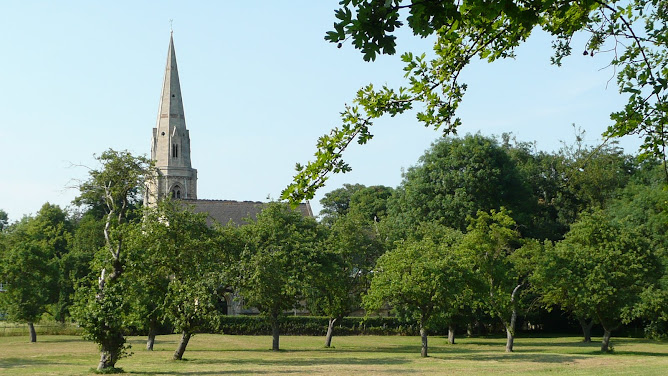
Walking around the woodland and grounds surrounding Nocton Hall today, you can still see the template of the private walks lined by mature trees, obscured by the neglected laurel hedging that has become much too large for its location. There is a collection of cherry blossom trees surrounding the former lawn to the South of Nocton Hall that are very impressive in Spring. You can still experience the grandeur of the large Wellingtonias and feel the soft hollow, fibrous bark in russet red tones.

Plate 15: This is how the 'Laurel Walk' on S side
of Nocton Hall used to look

Even today the grounds are well-wooded and many trees extremely fine, so much so they are under Tree Protection Orders... unfortunately though, the lime avenue to the east is no longer there, nor is the trout lake.

Plate 16: Old map clearly showing the Lime Avenue
and the trout lake

Many trees in the grounds of Nocton Hall now require attention and there are masses of saplings that need to be removed to allow more light to reach the woodland floor. However, work is long overdue to give these fine specimens the care and attention they deserve. That said, it is still a pleasant landscape in which to wander and dream what this place was like in its heyday.

Sources of Information:
  • Country Homes and Gardens: Nocton Hall - The Seat of Mr J Hodgson (Country Life 28 Sep 1901)
  • EJ Willson and the Architectural History of Nocton Old Hall (Author: Carol Bennett)
  • Nocton – The Last Years of an Estate Village – Vol 1 (ISBN 978-1-873257-80-7)
  • Nocton – The Last Years of an Estate Village – Vol 2 (ISBN 978-1-907516-13-9)
  • Nocton Hall Preparatory School for Boys 6-14 Years of Age for the Public Schools and Royal Navy (1937)
  • Sheila Redshaw Collection
  • The Revelations of an Imp (Author: Douglas Craven-Hodgson)

Sunday, 8 April 2012

A Prime Minister's Home

After attending All Saints Church this morning on Easter Sunday, I later came across an article when cataloguing Sheila Redshaw's collection of memorabilia.  I thought it would be nice to share this with you:

"Nocton.  A green and pleasant place a few miles south-east of Lincoln, it has a Hall which was the home of a Prime Minister, and a church which is his memorial and his last resting place.  About a mile away, on the edge of Nocton Fen and close to Nocton Wood, where lilies of the valley grow in great profusion, is the site of a priory founded in the time of King Stephen.

This priory, for Austin canons, was founded by Robert D'Arcy, whose father, Norman D'Arcy, a companion of the Conqueror, was first of a family which held this manor for 600 years.  In Charles the Second's time the estate was sold to Lord Stanhope, and then passed to Sir William Ellys, whose monument is in the church.  Later it passed to George Hobart, afterwards third Earl of Buckinghamshire, and the marriage of the fourth Earl's daughter brought it to the rising young politician who as Chancellor of the Exchequer was nicknamed Prosperity Robinson, and as Viscount Goderich succeeded George Canning as Premier.  He died as the Earl of Ripon in 1859, and three years later his widow built Nocton church in his memory.  It took the place of a poor church built by George Hobart, who had pulled down the old one because it was too near the Hall for his liking.

Designed by Sir Gilbert Scott in 14th-century style, and built of Ancaster stone, it is one of the most sumptious modern churches in all Lincolnshire, with a tower and spire 130 feet high, and a porch with niched figures of the Madonna and Child, St Peter, and St Paul, John the Baptist, and John the Evangelist.  The interior is dignified by an arcade on rich clustered columns, but is chiefly notable for the richness of decoration in carving, painting, and windows.  The heads of Peter, Paul, and of Our Lord are in niches on the lovely pulpit of stone and marble, and the alabaster reredos (by Italian craftsmen) shows under three gilded arches Christ carrying the Cross, with an angry man about to strike Him and a Roman sildier on a rearing horse behind; the Crucifixion, with the three women and the disciples; and the Entombment, with Mary Magdelene kneeling.  On each side of the reredos the wall is arcaded, the arches being filled with engraved figures of Apostles, Evangelists, Martyrs and Saints.

Elsewhere the walls are adorned with sacred subjects.  In the chancel are canopied paintings of Apostles and Evangelists, each with his symbol, and over the chancel arch Christ appears in Glory, with a great company of kneeling angels and saints.  More unusual are the paintings on the west wall of the nave - graphic illustrations of the Israelites entering the Promised Land, the Egyptians drowning in the Red Sea, and Noah with his family and the animals going into the Ark two by two, goats, asses, rabbits and snakes among them.

The windows form another fine gallery of pictures.  The east window has a central figure of St Michael with angels and a great multitude of men, women, and children round him; and 24 Elders below, casting their crowns before the Throne.  One of the side windows of the nave has figures of St Hugh of Lincoln and St Theodore, and a second has Oswald and Etheldreda.  A third window, showing St Aidan with the stag and the Venerable Bede writing, is a memorial to a descendent of William Brewster, one of the Pilgrim Fathers, and has smaller scenes depicting sunrise and sunset at sea and the Mayflower sailing the ocean.

The fine west window of the nave, with four scenes showing the gift of Isaac to Sarah, and four more of the gift of Samuel to Hannah, was the work of Clayton and Bell and is a memorial to the Countess of Ripon the builder of this church who died in 1867.

Among the monuments set up in memory of members of her family three are specially notable.  The first is of white marble with an urn to her father, Robert Hobart, the fourth Earl of Buckingham, Secretary of State for the Colonies in the first years of the 19th century and the man after whom the capital of Tasmania is named.  The second is to her uncle, Henry Lewis Hobart, vicar of this church for 33 years and Dean of Windsor as well - a white marble memorial with two kneeling women and cherubs above.  The third is the monument she raised to her husband, the first Earl of Ripon; it is under an arch between chancel and chapel, a stately altar tomb of Carrara marble bearing a figure of the Prime Minister in a long robe, his hands folded, his fine features in repose - a beautiful sculpture by Matthew Noble, the Yorkshireman who gave Liverpool, Manchester and London many fine statues.

The oldest memorial, and the only relic of the old church, is a pompous 17th-century array of marble columns, sculptured urn, helmet, shield, and Latin inscription; it is to Sir William Ellys, who built anew the Hall that Thomas Wymbish had erected in 1530, and which was visited by Hentry VIII and his fifth Queen, Katherine Howard.  Here she came with the ruthless king on a journey which was to end in charges which sent her, still a girl, to join her cousin Anne Boleyn in the chapel of death at the Tower.

Fire destroyed the old Hall in 1834, and the foundation stone of the new (handsome with mullioned windows, tall gables and chimneys, and terrace leading down to a lawn) was laid by Viscount Goderich's 14-year-old son, who was born in the most famous house in England (10 Downing Street) during his father's premiership.  He was to be for forty years associated with Gladstone.  Later in life, when he had become first Marquis of Ripon, and a Roman Catholic, he sold the Nocton estate.  He died in 1909 at his Yorkshire home, Studley Royal, and was buried there in a modern church even more sumptious than the one raised in his father's memory here.

Many fine trees surround the Hall, a veteran among them being a chestnut with a girth of about 35 feet and its great branches borne by a company of props."

Source: The Kings of England - Lincolnshire (1949) - P278/280
____________________________________

Thursday, 15 September 2011

Nocton Hall - Revelations of an Imp - Chapter 10

The younger Hobarts

In 1773, St. Peter's Church and vicarage which stood only a few yards from the Hall, was completely demolished and rebuilt on the present site of All Saints. Sir William's monument and the font were preserved and installed in the new St. Peter's which was little bigger than the original church inside the park. The graves and stones adjacent to the Hall were heaped together and buried in a mound south west of the new Hall and left of the present drive as it turns eastwards to the hospital. The old vicarage known as Widow Storey's homestead, shared the same fate and was rebuilt to the west of the present vicarage. The reconstruction work both of the new St. Peter's and the new enlarged Georgian vicarage, was completed on the 20th July, 1775.

In 1793, the Lord of the Manor, now the Earl of Buckinghamshire, agreed that John, son of Sir Edward Brakenbury of Raithby, Lines, should build a school in the village. John had fallen out with his father over his second marriage to Alice Tether, daughter of the tenant of Manor Farm and after leaving Raithby, lodged at the Plough Inn at the Wasps Nest, near the foot of Abbey Hill, the site of the old priory and Charles Brandon's manor house. John had a good education and after the birth of Justina, Alice's first child, they lived with Dr. Willis at the vicarage. Later the Brackenburys moved into a house converted from two cottages at the East end of Town Street from where he continued to run Nocton's first separate school, erected with the support of the village craftsmen.

The expected financial crunch of the Hobart's came in late January 1786. Albinia had gambled away so much money that the Branston estate was sold, but this still did not clear the vast debts amassed by her extravagances. Nocton had to be mortgaged before payment could be made in full to cover her debts of honour.George had, by both patience and skill prevented the total loss of their estates, but Albinia, a woman of great qualities, beauty and vitality had effectively destroyed the family fortune. George died and was buried at Nocton on 21st November, 1804 and Albinia who survived for 12 more years was buried by his side on 27th March 1816. Two of George and Albinia's sons, Robert and Henry lived to further enrich the history of Nocton. The younger son, Henry Lewis, studied theology and was instituted as vicar of Nocton in his brother's gift on 8th April, 1815. A year later he was appointed to the office of Dean of Windsor, a plum ecclesiastical post in the Church of England.

In the custom of the time, the children saw little of their parents other than when they descended from the nursery for a close physical inspection by father and mother and accompanied by the nanny, in this case Mrs. Field, the stewards wife. If you had a good report you received a little pat on the head, but if Nanny Field gave an account of bad behaviour, you would accompany father to the library for a severe lecture or corporal punishment. During your youthful upbringing with such stern discipline, it was generally a moment of pleasure when your parents disappeared down the drive for the journey to the Earl's London residence in St. James's Square. The old saying 'When the cats away, the mice will play' was the order of the day with Albinia's youthful flock. The Hall could turn a lighthearted game of hide and seek into a major rescue operation. The older children, with no thought for Nanny Field's natural anxieties, found hiding places even the staff were not aware of. There were moments in Mrs. Field's life when she seriously considered suicide if a child had been missing for an hour. Nanny was forced to speed to the servants hall for reinforcements. On rare occasions after an intensive search when the future Earl might still be missing, the great bell, hung on an outer tower, was sounded to let the world know a major crisis had developed in the nursery and Nanny Field was no longer in control of her charges. The staff, only too familiar with these situations, dropped everything. The additional backup of gardeners, coachmen and grooms widened the hunt. The children had a code of honour which was strictly observed. Hide and seek was either inside or outside the Hall, depending on weather conditions, but never inside and outside. At the end of one such exhaustive hunt, young Robert was found under a gooseberry bush in the walled in fruit garden. His brothers and sisters felt he had behaved like a traitor. It was an inside hunt and he had broken the code of honour. An unforgivable sin for young Lord Hobart. Nanny Field deserved a medal of honour for her patience beyond the call of duty.

Henry Lewis Hobart, in due time, erected a touching monument to this gentle lady which may still be seen to the west wall of the present vestry. The Dean, with his brothers and sisters had a deep love for their nanny, but boys will be boys and girls when egged on by boys are horrible. Their beloved nanny held their affection long after they had all grown into young men and women. Another dear lady who was able to help the strain thrust on Nanny Field when looking after young Hobart's was their governess nicknamed 'Snuffy Old Lady'. Albinia decided Mrs. Field should concentrate her efforts on the smaller members of the family. A room was set aside for the private tuition of the older children including Robert and Henry. Snuffy, their new governess, lived in a cottage close to the fish pond which in those days was near the present main gate to the Hall. The pond was fed by the Wellhead stream where the fish thrived on a plentiful supply of fresh water coming off the heath to the west.

Henry showed an intellectual standard above his brothers which pleased Snuffy. The friendship developed and as time passed, she began to tell him of tales of Nocton 'long ago'. One such story was about the old tavern which stood, in centuries past, on the site of the present Manor Farm and opposite the fish pond. The 16th century Inn known as the 'Silent Woman' by the villagers as the name had been changed from the 'Headless Maiden' at the time when Charles II bought the estate. Snuffy told the future Dean that many thought the headless lady was Lady Jane Grey. A spectre had been seen on many occasions by staff, both in the Hall and in the park, and always those who witnessed such a meeting, referred to the ghost as a 'grey lady'. Her story may have been based on the time when Lady Jane, with her sisters, lived at the Manor House, built by Charles Brandon on the site of the Priory which was later demolished by Sir William Ellys. The Queen's love for Nocton ran deep in her heart. Had she returned in spirit after her execution?

Many people have seen, in more recent times, an apparition of a 'grey lady', either in the grounds or in the Hall, but it would be a bold person to identify the spirit with the young Queen who was so brutally executed so long ago. The very mention of a ghost can send shivers down the spine, and as Snuffy expanded the story of the 'unnatural' to the willing ear of young Henry, he was subconsciously letting his imagination run riot in ways to scare his brothers and sisters. The old Hall was the perfect setting for enactment of ghostly nonsense, but whether Henry ever succeeded to chill the atmosphere to the degree necessary for spooky activity is not recorded. The future Dean, when he said his prayers before going to bed, may have thought the Almighty might disapprove of a prank to frighten his young companions.

When the Assistant Matron of R.A.F. Hospital, Nocton Hall tucked herself up in bed in the late evening of 2nd October 1981 she expected to awake the following morning refreshed after a good night's sleep. At 4 a.m. on the Saturday morning, she was awakened and close to her bed was the 'grey lady'. Matrons are accustomed to the unexpected but this was a situation which tested her usually calm nerves but in the fraction of a second, her surprise vanished. The lady was clearly a ghost, but friendly and these two, one a very real R.A.F. Officer, the other a person of a spiritual world, talked about our forthcoming visit to the Hall only 7 hours before our expected time of arrival. The 'grey lady' forecast an enjoyable time awaited everybody on my return home. Before she melted away into transparency, she promised to return the following morning at the same time. The Squadron Leader disclosed this 'happening' during lunch. It was clear the Commanding Officer felt a degree of discomfort listening to a tale of the supernatural from his No. 2 Officer. Such conversation may create false impressions and he was fearful we might think this lady's mind could be unbalanced. Our deep interest in the story soon dispelled such fears, but we never heard the outcome of a second 4 a.m. visit. We did hear that towards the time when the R.A.F. Hospital closed in 1983, the friendly lady ghost became more and more restless, but in spite of numerous visitations and appearances, her identification remains secret. Those who are sceptical of the unknown must heed the Nocton ghost. A Royal lady who reigned for 9 days in the mid winter of 1553/54 and died when only 16, is the most unlikely 'ghostie'. A ghost free of Royal connections brings her to a more humble level of society, but who will be the Prince to release her from her spiritual bondage so that she may join her friends from earlier Nocton days, in lasting peace.

We must return to reality and forget the ghost.

Henry Lewis Hobart married Charlotte Selina Moor, a descendant of the poet Milton's sister Anne, in Hampton Church on 5ht October 1824 and 22 years later, he died at the Georgian Vicarage built by his father at Nocton, on 8th May 1846. Amongst Henry's achievements, we must remember him as the only Dean of Windsor to have buried three Monarchs. George III, George IV and finally William IV. On one of these occasions, when the news reached Nocton of the King's death, all the estate workers were busy making hay. The Dean left the Vicarage and made for the fields to encourage the villagers to hurry as he wanted the horses for his coach to make the dash south to Windsor for the Royal funeral.

Robert and Henry's Father, the Third Earl died and was buried at Nocton on 21st November 1804 and was succeeded by the elder brother Robert, the fourth Earl, at the age of 44. When 32 he married on 4th January 1792, Margaretta, daughter and coheiress of Edmund Bourke of Urray, and widow of Thomas Adderley of Innishannon, County Cork. Margaretta died in 1796 after only four years of married life. The one child of this marriage, Lady Sarah Albinia Louise Hobart was a most important baby as we shall later find out.

The Earl's second marriage was to Eleanor Agnes Eden, daughter of William Eden, first Lord Auckland, but she died childless in 1851.

Eleanor had previously been engaged to William Pitt, the Tory Prime Minister 1783-1801, but Pitt 18 years her senior, instead of making up his mind and naming the wedding day, dithered about, in character with so many politicians, until the frustrated girl, driven to desperation, leapt into Robert Hobart's arms. Pitt lamented his indecision when he realised the girl was to become a countess. He remained a lifelong bachelor and applied himself totally to politics in the Lower House until his creation as Earl of Chatham.

In order to avoid a lengthy dialogue on Robert, his career has been condensed.

George and Albinia sent him to Westminster School and in the tradition of the time, he joined the army when 16 with the rank of Lieutenant in the Royal Fusiliers. His regiment served in the American War of Independence and during this campaign, obtained the rank of Captain. In August 1783, the army transferred him with the rank of Major to the 18th Regiment of Light Dragoons. He became aide-de-camp to the Duke of Rutland, Lord Lieutenant of Ireland in 1784 and remained in this post to Rutland's successor, George Nugent-Temple-Grenville, Marquis of Buckingham.

In 1788 Robert was elected for Lincoln in the English Parliament and retained the local seat for six years.

His first wife, Margaretta, an Irish heiress, strongly influenced his political career for he served more in the Irish Parliament than in England, whilst continuing his services as secretary to three Lord Lieutenants, the last being John Fane, tenth Earl of Westmoreland. Staunch anti-Catholic views were to make him unpopular, but on his uncle's death, he returned to England where his political career continued in the House of Lords.

Appointments listed amongst Robert's political successes came when he was made firstly, an Irish Privy Councillor and later elevated to the same office in England.

In 1793 when 33, he became Governor of Madras with a provisional promise that he might succeed to the Governor Generalship of India. Hobart arrived in Madras in the summer of 1794. He was still very much at heart a soldier. The memory remained with him of the disastrous American War of Independence when he had last seen active service. Determined to correct his personal record, he prepared an expedition to attack the Dutch settlement in Malacca. Although the Dutch occupation was eliminated and the attack was a total success, the political reaction was less favourable. The Governor General, Lord Teignmouth, felt Hobart's action was inexcusable and the act of an aggressive individual. Further radical attempts by Robert to adjust and improve the way of life for the lesser man in his state again brought him into conflict with Teignmouth.

It was clear the political objectives of the two Englishmen were the same, yet Hobart's 'high speed' methods of reform against corruption, alarmed his senior.

Reports sent to London had weakened political opinion at home and destroyed any hope that young Hobart would become Governor General. On his recall in 1798, after four years service, he received an annual pension of £1,500 but this compensation did little to Robert's morale. The post of Governor General had been his ambition, a post beyond his grasp. 82 years later, Nocton sent out the Viceroy, the position so longed for by Hobart. In 1804, Hobart Town in Tasmania was founded and named after him and in the same year he became the fourth Earl on his father's death.

In 1812, having previously held post in the Colonial and War Departments, the Chancellorship of the Duchy of Lancaster and Postmaster General, he was then appointed by the Tory Prime Minister, President of the Board of Control on Indian affairs in the administration of Lord Liverpool.

In 1816 the Earl was riding in St. James Park when his horse suddenly stumbled, then reared sharply throwing his rider. The fall proved fatal and Robert died on the 4th February aged 56. George Hobart, his nephew, became the fifth Earl but took his seat at Great Hampden. Nocton and the estate came to Robert's daughter Sarah, who married the second son of the Earl of Grantham.
_________________________________________________________
Wednesday, 14 September 2011

Nocton Hall - Revelations of an Imp - Chapter 9

The Hobarts

In 1764/5, Nocton passed to George Hobart whose father had died in 1756. The Dashwood's stepped aside to give this young man his inheritance and fulfil Sir William Ellys' wish, even though Sarah could have retained the estate until her death. Those who may have blacked Sir Francis' character must recognise this generosity, on their departure from Nocton, they effectively lost an income of over £5,000 per year. Lady Le Despenser died 19th January 1769 and Nocton said farewell to a great lady.

George was 31 when he arrived at Nocton Hall with his wife, Albinia, daughter and coheiress of Lord Vere Bertie, Duke of Ancaster. This marriage on 22nd May 1757 created the possibility of an estate stretching from the southern boundary of Lincoln to Metheringham. A vast area of rich land.

The Duke's seat at Branston Hall rivalled Nocton both in size and beauty. The Bertie countryside was well laid out and rich in fine hardwood. The Park was likewise enhanced with established oak, beech, lime and elm. Lord Ancaster looked upon his hardwood trees as the mouth and nose of mother earth by which his land would breath God's fresh air and fertilize and prosper both stock and ground.

George and Albinia soon moved into the active social rounds of life in the county after they took up residence in 1766. The demands for Hobart's political service had prevented an earlier return to their Lincolnshire estate. On the completion of his work in St. Petersburgh in 1765 as secretary to the Ambassador, these two very good looking aristocrats had everything going for them. George had come from his post in the British Embassy with flying colours and he had proved reliable and conscientious as a Member of Parliament for St. Ives, Cornwall. Albinia had developed a weakness for the gaming tables, but what could her husband say, for she gambled with her own money and credit, backed by the Branston estate, which gave her enormous wealth to risk on a game of chance. George continued to feel nervous of his wife's addiction. It was a relief to escape from London where their home, in what is now referred to as Hobart Place, was adjacent to Buckingham Palace. The countryside of the Nocton estate gave him the greatest satisfaction and to be safely away in the heart of rural England could possibly break his wife's obsession.

The Hobarts entertained at the Hall on a grand scale. A house warming party given on 29th December 1767 let everybody know they were 'in residence'. The party took the form of a masquerade. In mid-winter, their home made a perfect setting for a great ball. The lanterns festooned from the trees on the drive side through the park added a romantic touch to welcome the guests arriving in their coaches. The octagonal lantern tower illuminated the forecourt to give the travellers plenty of light as the coachmen drew their carriages close in the entrance. Footmen gave assistance to the ladies in their magnificent costumes. It would be an unforgivable sin to allow a gracious lady to go 'ass over tip' in the snow. When it did happen, the offender would suffer, not from the anger of a noble Lord, but from his own kith and kin at the staff dining table. The more a footman tried to explain away his crime, the greater the uproarious laughter. The Lincolnshire yeoman has a wicked sense of humour. When the culprit was on the run, there was no let up. First the butler, then the cook, followed by lesser mortals, teased the poor lad amidst giggles and cries of 'Tell us just what you got up to'.

Upstairs, the pomp and ceremony of the early introductions over, the gentle thaw set in to break the shyness of the introverts. The usual flow of alcohol disguised by such as 'a coachman's hat', 'sidesaddle', 'knickerbocker' and 'blacktea', removed barriers between the sexes. The party was away with a swing and the Hall rang to the sound of music with human tittle tattle, unlike anything in the animal world during the softening up period when boy meets girl. Albinia, with her untiring energy, motivated the gaiety and was acclaimed the best party organiser in the county. Among the guests for the December get-together were the Duke of York, the Marquis of Exeter, Lord Nevile, Albinia's parents, Lady Betty Chaplin, Sir Cecil Wray, the Huttons, Sibthorpes, Custs and Amcotts and the high flight of Lincolnshire 'upper-crust'. Albinia created a gasp when disposing of her black cloak with a fitted hood, complete with two ears, she revealed herself as a leopard in a skin tight silk costume. The dress had to stand harsh treatment. Leopards have tails and Albinia's was too tempting to be allowed to dangle. A few adventurous tweeks from the revellers split the delicate fabric and the horseplay enforced a quick change.

George, when looking into ways to improve the estate, conceived an idea of planting a lime avenue on the eastern side of the Hall. It was to be approximately a mile in length and on either side of the open ride, the trees were double planted. This gave the layout a firmer look with the appearance of an extended view well beyond a mile towards the horizon.

In Lord Ripon's time, a hundred years later, these trees had developed into robust timber with a fine canopy, giving a superb view of the avenue from the lounge and dining room windows.

George Hobart's conception had materialised into a noble feature of the park to beautify the Nocton landscape.

Albinia's father, the Duke of Ancaster, influenced by the drainage work of the Earl of Lindsey, a century before when he had increased the acreage of the Lindsey estates in south Lincolnshire by some 24,000 acres, set about a similar operation on the Branston Fen. To make the scheme a permanent success involved major work in raising the dyke embankments in the parishes of Nocton, Potterhanworth and Branston. An Act of Parliament dated 1789 (George III) sanctioned this development. A wind engine was used to eject the water from the fen on these estates, across the raised bank, into the river Witham. For forty years, this innovation kept the water drainage under control.

The first Earl of Ripon did away with the wind engine and replaced this primitive method with a steam engine to power the pumps, but several times the water levels rose high enough to convince the farmers that the latest improvement was not to equal to the fullest force of extreme weather conditions.

In the time of Norman Hodgson, a new and more powerful steam engine was installed to drive water ejection pumps of far greater efficiency. This engineering project was housed in a pumping station on Nocton Fen. A visitor was immediately impressed by the standard of cleanliness in the engine house. Anyone wishing to look around this new drainage wonder, was asked to remove their boots or shoes. The resident foreman in charge, Mr. Kent, observed his glittering and highly polished machinery with great pride.

It was said that when the time came for the ultimate test after a long period of rain, Boston and the surrounding country was flooded by the abnormal rise of the River Witham. Perhaps an exaggerated story, but the local fens on the west bank of the Witham from Branston to Dunston had the dykes pumped dry in half an hour.

George Hobart, when not managing the Nocton estate, remained involved in political work as a active Member of Parliament until 1780, but his anxiety over Albinia's obsession to gamble, remained a continual worry. He made every attempt to help his attractive wife overcome this weakness. Eight children evolved from this marriage, four sons and four daughters, the eldest boy, Robert, born 6th May 1760, was to succeed to the title.

The Earl encouraged Albinia to mix with Lincolnshire society. In 1799 she became Patroness of the Lincoln Stuff Ball which was held annually. This evening of gaiety was first celebrated in 1785 and organised by the Rev. R. G. Bower. The more serious purpose of this annual event was to encourage the use and sale of native wool and to raise money for charity. On the initiation of the Stuff or Colour Ball, 300 guests attended from all over the county and different distinguished individuals acted as patron each year. From 1787-1801 the following personalities fulfilled this function:-

1787 Mrs. Bowyer
1788 Lady Theodosia Vyner
1789 Lady Banks
1790 Elizabeth, Lady Monson
1791 Duchess of Ancaster
1792 Lady Brownlow
1793 Lady Thorold
1794 Lady Mary Milsington
1795 Charlotte, Lady William Beauclerk
1796 Lady Theodosia Vyner
1797 Mrs. Bertie
1798 Hon. Mrs. Fane
1799 Albinia, Countess of Buckinghamshire
1800 Mrs. Chaplin
1801 Maria Janetta, Lady William Beauclerk

The regulation clothes for the evening had to be made of wool and in the colour decided by the patroness. Because of the heat generated by a dress made from top quality wool, the ladies influenced their designs to show as much of their birthday suits as possible, to the satisfaction of their escorts. When in London, Albinia's breakfast parties in her house adjacent to Buckingham Palace were famous as a meeting place for the smart and interesting members of society.

George, ever mindful of a precarious financial crisis developing as Albinia's debts mounted, set to work with a will to extend the Norton estate and take in a further 4,500 acres of land still lying waste on the heath and fen. The old custom to fence in after a certain time to call your own, increased the estate to over 7,000 acres.
___________________________________________________

Tuesday, 13 September 2011

Nocton Hall - Revelations of an Imp - Chapter 8

Stanhope, Ellys and Dashwood

Lord Charles Stanhope moved to Nocton Hall from his own home at Harrington Hall, adjacent to the home of Lord Tennyson, near Horncastle, 1662.

The new owner was 68 and had come through the previous years as a voluntary exile whilst the civil war raged. He had been created a knight of the Bath in 1610 on the creation of Henry, Prince of Wales but, realising England was no place for a senior baron, retired overseas to allow the rebellion against Charles I to blow over. He was fortunate to be in Holland when the future King arrived to join a number of other senior sympathisers of the Crown. It was clear Charles II held the advice and wise counsel of this baron with the greatest respect.

Stanhope had married Dorothy Barrett, sister of Edward, Baron Newburgh, but had no issue. It is thought Stanhope died and was buried at Nocton 1675.

At his death, Stanhope's nearest relation may have been Sir William Ellys but it is necessary to retrace the family tree to Sir Michael Stanhope of Shelford in Nottinghamshire who was beheaded in 1552. His great grandson's daughter Ann had married Sir Thomas Ellys and it was their son who now inherited Nocton from Charles Stanhope.

Sir William, born in 1653, was only 22 when he had the good fortune to benefit from Charles Stanhope's will but, although young, he was already a wealthy bachelor. His family had close relatives on both sides in the civil war; the most famous, John Hampden of Great Hampden in Buckinghamshire, killed at Edgehill, had three children - Richard married to the daughter of Lord Paget, Ruth his second child, married to Sir John Trevor and the youngest, Mary, married to Sir John Hobart a relation of Nathaniel who had by the narrow margin of one, carried the vote in the Commons to confiscate Lord Craven's estates.

The deep agony of divided families when they took up their positions either for or against the Crown, showed the strain on the loyalties of such individuals. A glance at the genealogical tree shows the divide clearly, on one side Stanhopes, the other Hampdens.

Mercifully when Charles returned and the Crown was restored, these antagonists were prepared to forget the past so that their broken relationships could once more be united in peace. Charles Stanhope's legacy illustrated his gentle and flexible nature. William Ellys had, under the influence of a family supporting Cromwell, favoured Parliament but Charles Stanhope was determined by his example, to unite rather than destroy. He recognised the qualities of his nephews and nieces, trusting their judgement in the selection of husbands and wives. He was a man who put family unity first and placed Nocton in safe hands from the time of his death.

Canon Footman records Sir William's great uncle's activity and involvement with Nocton through the latter part of Stanhope's life. Sir William's great nephew, in thankful recognition for his abundant inheritance, placed a monument to him in Nocton's Church. When you first set eyes on this colossus, remember it was moved three times to its final resting place under the bell tower of Lady Ripon's memorial Church to her husband. The two previous churches, on close to the Hall, could only be regarded as chapels. The Nocton Villagers viewed this as a mighty respectful monument to show gratitude to the man who had endowed the new squire with great wealth.

The story of Sir William, so well remembered by this memorial was born about 1609 and later baptised in Grantham Parish Church. After an education at Christ's College, Cambridge, he was admitted as a student at Gray's Inn and later called to the Bar in 1634. In 1639 he became Recorder of Boston and represented the borough in the Long Parliament.

On 6th December 1648, he was expelled from Parliament by Prides Purge, but after the King's execution in 1649, he was re-admitted. He became Member of Parliament for Grantham in September 1656 and was appointed Recorder of the Borough. In 1657 he was created a Baronet and in 1658/9 he again held the Grantham seat and under Richard Cromwell, Sir William became Solicitor General. Sensitive to public feeling, he adopted a discreet attitude to prepare for the restoration of Charles II, but these personal manipulations came too late to save his disgrace which culminated in the loss of legal offices and withdrawal of the baronetcy. Thomas Ellys of Wyham who had married Ann Stanhope (mentioned earlier) interceded to save his uncle sliding into greater humiliation. This nephew had served the Stuart cause and for his steadfast faith had been created a Baronet in 1660. Thereafter, his uncle quietly pursued his profession at the Bar but with the political change of wind and help from close relations, became a chosen Reader of his Inn about 1663, Sergeant in 1669 and by 1671, now in total favour with Charles, was created a Sergeant at Law to his Majesty, followed with the addition of a knighthood.

He was in 1672 living at Welbourn when he was created a Judge of the Common Pleas. His death came in 1681 at his chamber in Sergeants Inn, Fleet Street on 2nd December. A bachelor to the end. He had appointed Richard Hampden, the brother of Mary who had married Sir John Hobart of Blickling in Norfolk as supervisor of his will and all his worldly goods passed to the grand nephew William at Nocton.

When visiting Nocton, Sir William Elly's monument is worth an inspection. You will find it a remarkable and still in perfect condition after 200 years. Walk through the rear of the Church and open the massive door of the bell tower. There before you on the east facing wall is this 'Gigantica'. Modern engineering skills would be tested in the erection of such a vast epitaph. It survived two moves from Nocton's earlier small churches before it was placed in its final position by the ingenuity of Nocton craftsmen. Those of you who are able to read Latin, will note the long inscription declaring the mutual affection of Sir William of the third generation to Sir William of the first generation. A suggestion that grand uncle William bought Nocton from Lord Stanhope and left the estate to his grand nephew, is without foundation. A connection did exist, for in his capacity as a lawyer, he had acted for the previous owners over financial arrangements which had to be cleared before Lord Stanhope's will, passing Nocton to Sir William of the third generation, could be effective.The volume of legal work in the aftermath of the Civil War delayed the completion of wills and there was a heavy backlog in the conveyance of estates which created a very profitable time for the legal profession. The wealth and style of life for many in this work showed in their large houses and estates.

Young Sir William, recognising his good fortune, may have over reacted, but he left for posterity, a unique example of how to say 'Thank you' in true style of a man now living in the late home of a Monarch.

In 1672, young William Ellys had married Isabella, the daughter of Letitia and Richard Hampden. It was undoubtedly a successful marriage for the loving couple had no less than twelve children. Sir William now decided that Nocton Hall must rank in status amongst the great houses of England. He called in the best professional architects and set about adjusting and enlarging his home. The basis of this development was to resemble the Hall as a letter 'E' after the initial of his surname. In order to give an air of importance, the two wings were capped with cupolas and in each was a solid stone winding stair which, when climbed to the top, enabled one to see through the window under the cap. In the centre section of the 'E' was the front door and the roof was again capped with an even greater octagonal cupola with large leaded windows which gave the effect of a lantern house at night "when the candles were lighted. The structure of the entire Hall was in brick with stone principles, except on the extreme north wing which maintained the original complete stone of the Hall dating back to the eleventh century and which, in part, still stands. At the time, it was referred to as a 'magnificent seat'. Today, we refer to the once great home as the 'Old Hall' for it burnt down in 1834.

Sir William went to untold lengths to achieve his idea of the perfect home. On the west garden wall, almost opposite Nocton village, one can see the face of a late Jacobean house built into the park wall. In the R.A.F. Mess, it was referred to as a 'folly' but Sir William, in an attempt to present the entire focal point of the Hall with an attractive balanced view, decided to try a full scale replica which, if suitable in appearance, would then be used for his entrance and middle section. The result was a calamity, but this did not deter Sir William who immediately extended the building through the park wall, using the experimental face as the east section of a small hall. On completion, it was known as the 'Pheasantry' and became a 'nosh house' for all comers. Twelve dishes were provided daily for travellers who cared to call. Ale was also provided in pewter tankards, marked 'Nocton Hall' to wash down the meal. A large pathway ran from the Hall to the wayfarers Pheasantry to allow the Hall staff a dry walk with the food and ale when it was delivered each day. The tradition introduced by Sir William was continued for the next 250 years and maintained by my family until we left the estate.

Sir William made further alterations and successful developments to the parkland and estate. Large areas were planted with oak, ash, lime and good quality hardwood. This was done with an ever watchful eye to make sure good land was preserved for farming whereas the poor ground, when planted, enhanced the beauty of the countryside. Wind breaks were an essential part of the improvements and in the years to come, this wood development on the estate provided Nocton with a landscape of incredible beauty. Snowdrops, bluebells and lillies of the valley grew in abundance, spreading as each season passed. In May, the scent of the flowers, wafted by a gentle breeze from the woods, gave a satisfaction that made one feel good to be alive.

During the Nocton Hall 'facelift' the estate was to lose Charles Brandon's Manor House, built on the site of the Priory. Regretfully, the stone of both the Priory and the Manor was used in the reconstruction work at the Hall to such an extent that little remained to mark the passing of these two historical places. In the tradition of the past owners, Sir William played an active part in public life. He was elected Member of Parliament for Boston in 1678 and later sat continuously for Grantham from 1678-81 and from 1688-1710, a period of 25 years in Parliament.

His beautiful wife, Isabella, died in 1686 and he outlived her by a further 41 years, passing Nocton to his eldest son, Richard, when he was 44. Richard's first wife, Elizabeth, daughter of Sir Thomas Hussey of Doddington, died in 1724 at the age of 36. Elizabeth's home at Doddington is architecturally similar to the old Nocton Hall, with the same brick and stone blend associated withthe late Elizabethan period. His second wife, Sarah, came from Iver in Buckinghamshire and she was to outlive Richard who died in 1742 at the age 61.

Richard followed the family tradition in politics. He was a Member of Parliament for Boston 1714, 1722 and 1727. His other interests centred on his strong academic qualities covering books and theology. An accomplished scholar, he published a book in Latin called 'A Critical Examination of Doubtful Passages in the Greek Testament', a work of great dedication and practical use for future ecclesiastical scholars.

It was not surprising that the library at Nocton was acquiring a remarkable collection of specialised books with an owner who indulged in such research over a wide field and required information on so many subjects.

Richard in his will prepared in 1740, two years before his death, was to surprise many hopeful relations and friends, including Horace Walpole, the son of the first Prime Minister, Robert Walpole, later created the first Lord Orford. By the greatest good fortune, the library at Nocton, which now housed over 10,000 books, was left to Lord Hobart at Blickling Hall, Norfolk.

In due time, the widow, Sarah Ellys, sent off these antiquarian and theological volumes to Blickling, otherwise this vast collection would not have escaped the destruction of the Hall when it was burnt down nearly 100 years later.

Sarah inherited the estate for life. It then passed to Richard's second cousin, Lord Hobart, the first Earl's son by his second wife. Sarah was, in due time, to surprise her friends and society. She remained a widow for four years before marrying none other than Francis Dashwood Esquire. What a contrast. Her first husband, a quiet and studious scholar, fathered no children during their marriage. The record of her second husband is without parallel. The male sex symbol of the 18th century.

Before we look into the private life of Sarah and Francis, we must go to Blickling, from where the future owners of Nocton would come, and in order to sort out the family merry-go-round of who went where, the Nocton genealogical tree helps to discover the 'beginnings' of the changeover.

Mary Hampden's marriage to Sir John Hobart took her to Blickling Hall, once the home of Harold, Earl of East Anglia, King of England. William the Conqueror gave the Norfolk property to his Chaplain, Herfast, and created him Bishop of Thetford and later Norwich. This historic home, in the 16th century, became the property of the Clere family, related to Anne Boleyn, but Sir Robert Clere's high living, forced the scale of the estate which was brought by Sir Henry Hobart about 1616. Sir Henry's family had amassed a fortune for their legal services at the top end of the profession when James I founded the Order of Baronets in 1611. Hobart, then Lord Chief Justice, was duly enrolled. Sir Henry, like Sir William Ellys, gave Blickling Hall a complete rebuild to notify friends and neighbours that he was accustomed to a society with the best of living standards.

In the years to come, the squires of Blickling quickly climbed the ladder of success. A mixture of politics and law provided rich returns to support the family fortune and provide all the goodies necessary for Sir John Hobart when he became a Peer in 1728, followed 18 years later by his creation to the Earldom of Buckinghamshire.

His sister, Henrietta Howard, Countess of Suffolk, played a successful role in promoting her brother to such an exalted position. Her friendship and association with George II with her persuasive charm, speeded the family advance up the aristocratic climb. Horace Walpole found the Countess equally entertaining. She was a woman of high intellect and he found her stories of her association with the King, fascinating. Whether she was the Royal mistress, we know not, but whatever her relationship with the King, it proved successful for her brother. She was dark, tall and beautiful, and with these female qualities added to her high intelligence, formed close friendships with Pope, Swift and members of the Court, including the Earl of Pembroke. This brought her the achievements and influence she sought. Her Husband, the Earl of Suffolk, was asadistic character who subjected her to a miserable existence, but eventually they were separated. She remained a staunch and loyal family friend and her nephew John wrote continually to her during his time in St. Petersburgh.John Hobart, the second Earl of Buckinghamshire, a handsome and distinguished character, took his Earldom in 1756 after the death of his Father and became Lord of the Bedchamber - an appropriate appointment for such a progressive blood. In 1762, he was appointed our Ambassador to St. Petersburgh by George III who felt his manly qualities and good looks could influence the powerful Catherine the Great to support policies in favour of Great Britain.

From the moment of his arrival in Russia, the noble Earl certainly conquered many a lady's heart. When he had completed his three year term of office, Catherine requested George III that his service at the Hermitage be extended for another year. The King acceded to this request from the Great Queen, but after four years, John had to return home. In his position of Ambassador, he cemented a close affection for our country with the Russian aristocracy who presented the Earl with a solid silver medal in token of the great happiness he had bestowed on 105 ladies of the Court. The Palace in St. Petersburgh was reputed to have forty miles of passages. The second Earl must have been a very fit man. An Ambassador of today could not be expected to emulate the Earl. The Kremlin, with its stark appearance, does not create an atmosphere for romance and it would be beyond the call of duty, at the present time, to follow the good will created by John Hobart. In 1777 he became Lord Lieutenant of Ireland for a further three year period. He was remembered with affection across the Irish Sea by his wholesale creation of peerages, but like so many Englishmen, he found little happiness in his high office in Ireland, except for one momentous pleasure. Having lost his first wife when she was 29, he found love again with Caroline Conolly and they were married when she was only 17. Her portrait by Gainsborough leaves the viewer gasping. The Earl was truly blessed with a most beautiful bride. She gave him all the compensations any man could have wished for and in their love for each other, he forgot the frustrations of his Irish appointment. The Earl's death in 1793 brought about an exchange of titles for Blickling and Nocton. John's estates in Norfolk passed through a daughter's family to the Earl of Ancrum, and later the Marquess of Lothian (the fourth Marquis married Caroline D'Arcy only daughter of Robert, third Earl of Holderness). John had no male heir and Nocton then became the seat of third Earl of Buckinghamshire, George Hobart 1732-1804.

We now return to Lincolnshire, Sarah and Francis Dashwood remained at Nocton for four years after their marriage. It is no disrespect that this exceptional character is referred to as Francis Dashwood Esquire for he had not inherited his title at the time of the marriage to Sarah. His time at Nocton was not to be wasted. The magnificent appearance of the Hall fascinated his fertile imagination during his courtship. The octagonal lantern tower, high above the central portion of the Hall was to both lovers a place to which they could retreat and to be alone to themselves. Here they both looked out across Sarah's great estate. To the north west, the tips of Lincoln Cathedral broke the skyline. The other views were across the Hall gardens and woods into the distant countryside. Potterhanworth village, only a mile away to the north stood out clearly. The Nocton Fen and the Priory site on Abbey Hill to the east, to the south Dunston and Metheringham and to the west the notorious heath. As the sun dipped in the west, Sarah and Francis stood transfixed by the sheer beauty of the closing day. The two exchanged thoughts. Sarah, her domestic fulfilments and Francis, his love for Sarah and his political ambitions. The sky darkened, the blood red sun like a ball of fire, dipped below the western horizon. When the candles had been lighted, the two descended the spiral stairs and returned to the inner comfort of the Hall, but the brain of Francis would not rest.

A fantasy of religious devilry had crystallised in his vivid imagination with the ball of fire to the west and the Priory to the east. Nocton had provided a witches brew. The potion must be taken at all speed to Buckinghamshire and West Wycombe where Sarah's future husband founded the Hell Fire Club. Nocton's octagonal viewpoint had fuelled the creative mind of Francis. The fullest ritual of the 'Holy Brotherhood' of the Hell Fire Club with the 'Friars' in attendance wearing their robes of office was held at Medmenham Abbey in 1752, when penance was paid to the creator 'St. Francis of Wycombe'.

After the restoration of Medmenham Abbey, the brotherhood of unholy friars of St. Francis who attended the inaugural meeting included the following cross section of intellectuals of that time - namely:


John Wilkes - Demagogue
Charles Churchill - Satirist
Robert Lloyd - Poet
Henry Vansittant - Governor of Bengal
Robert Vansittant - Requis Professor of Civil Law at Oxford
Arthur Vansittant - Member of Parliament for Berkshire
George Selwyn - Wit
John Stewart, Lord Bute - Prime Minister 1762
Dr. Benjamin Bates - Physician of Aylesbury
William Hogarth - Painter
Sir William Stanhope - Relative of Lord Stanhope of Nocton and son of Earl of Chesterfield
Evelyn Pierrepoint - Duke of Kingston, relative of Robert De Pedwardine through his wife John Manners - Marquis of Granby
John Montague, Lord Sandwich - First Lord of the Admiralty
Paul Whitehead - Poet and political writer
George Bubb Doddington - Baron of Melcombe Regis, Dorset
Thomas Potter - Paymaster General and Joint Vice Treasurer of Ireland
Francis Duffield - Artist and landowner at Medmenham
William Douglas, Earl of March - High liver
Henry Fox - Lord Holland
Sir John Aubrey
Henry Loviband Collins
George, Lord Orford
Sir Francis Delaval of Doddington near Lincoln
Sir John Vanhattan
Sir Thomas Stapleton
Mr. Clarke of Henley.

Their activity behind closed doors fired the imagination and those whose interest went beyond curiosity, allowed the word to spread that the 'Friars' indulged freely in all the 'sinful lusts of the flesh'. Sir Francis associated with Venus and other deities may have indulged by fuelling this 'fire' of the 'do gooders'.

Many envied a close order where complete bodily freedom was expressed without restriction. Is it not possible that Francis set up the 'Hell Fire Club' as the greatest leg-pull in history?

It must be said that what the R.A.F. Hospital at Nocton referred to as a 'Dining in Night' far excelled any 'hanky-panky' motivated by Sir Francis. His spirit must have been very much in evidence at these parties in the Hall and would have made him feel at home and perhaps bring back memories of the days when he joined Sarah in the lantern tower - moments of bliss, never forgotten.

Nocton can bear no malice that one of its sons developed such an eccentricity. Sir Francis built his own monument by which Nocton and Lincolnshire will remember him.

On occasions, travellers making their way from Sleaford to Lincoln had been confronted by highwaymen on the bleak western heath of Nocton and Dunston. One holdup ended in murder when the victim, Christopher Wilkinson, who refused to hand over his money to Dick Turpin, was found dead and later buried at Nocton.

Francis was determined to make the road safer on the western edge of their estate by the erection of a land lighthouse, similar in design to the central cupola on Nocton Hall. It was to be much higher to make sure the beams of light would spread across the extensive brush waste to deter highwaymen. In 1751, the Pillar rose into the sky. During the work, so many people gathered to watch the building that it was impossible for men of evil intent to attack a lone traveller. The people in the surrounding countryside rode over on horseback to watch the erection going up and up. Steadily the work advanced until the Pillar began to break the skyline in every direction. It was no simple task building the structure of stone, 92 feet in height with an octagonal lantern top 15'/2 feet high. An inner staircase carried the lighthouse keeper to the gallery which surrounded the base of the lantern.

The view from this 108 feet tower was extensive and magnificent. Lincoln Cathedral stood out to the north and on a clear day, even Boston Stump could be seen to the far southeast. The area on which the Pillar stood gave it a central position on a square, enclosed by a stone wall and surrounded, except on the west, by plantations. At each corner of the perimeter wall was a building, and on the north side, the lightkeeper's house.

A daily stream of people visited the Pillar both to stand and gaze or to climb up to the gallery and look across the Lincolnshire views. It gave Francis pride when he climbed the Hall tower in the late evening to look west and see his achievement three miles away lighting up the sky.

In the passing of time, this open and inhospitable brush waste was fenced in and is today good farm land. The lantern gradually collapsed as the ironwork rusted and it was replaced with an enormous stone statue of George III, erected by the resident Earl of Buckinghamshire. The King was not flattered when the Earl told him that to celebrate his 50th Anniversary on the throne, he had been placed on a stone pinnacle on the top of a 90 feet tower on Lincoln Heath. A steeplejack regretfully lost his life either placing or removing the noble King from his plinth. The remains of George Ill's statue has been placed in the Lincoln Castle grounds.

On the sides of the Pillar appear the following inscriptions:-

North Side - To Lincoln… V Miles
South Side - From the City… CXX Miles
East Side - Dunston Pillar
West Side - Columnam Hone… Utilitate Publicae… D.D.D. F. Dashwood… M. DCCLI

By 1751, Francis had become a baronet. The neighbouring estate owners of Nocton invited him to attend the Fen Drainage Meeting at the White Hart Hotel in Lincoln on 15th November 1753. The Duke of Ancaster took the Chair. He held a proxy from Sir Francis who was at his Buckinghamshire home.

In November 1761, Lady Dashwood's name appeared as a subscriber towards the expenses in promoting the Witham Drainage Bill in Parliament. The Act was passed in 1762 and the work of draining thousands of acres in the Witham Fen gave an immediate advantage to this low ground's fertility. Increased rents, which increased income, cheered the land owners including Sir Francis and Lady Dashwood. Nocton had over 2,000 acres of black soil between the Nocton escarpment and the River Witham - about a third of the estate which from Roman times had been unproductive. Dashwood's career in Parliament enlivened the House. Dull sittings were crystalized into verbal exchanges as his orations had a habit of arousing even the deepest sleeper on the benches. Admiral Byng's sentence to death evoked his deep passion but his forceful defence of the Admiral failed to save this poor sailor from capital punishment.

In 1762 he became the Chancellor of the Exchequer in Lord Bute's Tory administration. His budget speech was so confused and incomprehensible that it was received with shouts of laughter. Francis was under no illusions that he had bodged the speech. People will point at me and say 'There goes the worst Chancellor of the Exchequer that ever lived' but he was to be remembered in the years to come; it was a good budget for the people and this is what a nation will remember.

In 1763 Sir Francis succeeded his uncle in the right of his Mother, Lady Mary Dashwood, daughter of the fourth Earl of Westmoreland, as Lord Le Despenser. The connection in past history of a gentleman bearing that name who had served Edward II would not have escaped the members of the Hell Fire Club. The very man to live down such a remote connection with homosexuality, was Sir Francis. On the one hand, an effeminate and slimy creature, on the other hand, an outspoken and generous person with the courage of a lion who used outrageous methods to destroy superstition within the Church and gave his fellow individuals a conscience unshackled from the belief of 'hell fire'.
___________________________________________________________________________